11 min read

Mohammed Al-Anazi
Product Manager at Salla
Would you like to read a summary of the article?
Summarize with ChatGPT
Summarize it with Claude
Summarize it with Perplexity

Building an Abaya brand from scratch does not start with the logo or packaging, but rather with your target customer and an elegant abaya that solves a clear need for her. After that, you design your first small collection, choose the fabric, implement a sample, calculate the cost, and then display the products in a store that explains everything the customer needs before purchasing.
In this guide, you will find a practical five-step journey, from the first idea to testing a complete order from a mobile phone.
Why is an Abaya brand different from a general clothing brand?
The abaya is an essential and recurring piece in the wardrobe of many customers in the Saudi market. A customer may buy an abaya for work, another for daily use, and a third for an occasion or travel. Therefore, her need to purchase can be repeated more than some ready-to-wear categories, especially when she trusts the size, material, and quality of implementation.
As for a general clothing brand, it may serve many categories, such as dresses, shirts, and pants, and is more widely affected by changing seasons and sizes. An abaya brand can start with a more specific promise, such as light, practical abayas for work, wide cuts for occasions, or quiet designs for daily use.
This focus alone does not guarantee sales, but it makes design, fabric, pricing, and photography decisions clearer, and helps the customer understand the brand quickly.
Start by identifying your target customer
Do not say "my abayas are suitable for everyone." Choose a target customer and a primary use for the first collection, then write clear answers to the following questions:
When will she wear the abaya: at work, daily, on an occasion, or during travel?
What bothers her most when buying an abaya: size, fabric weight, transparency, sleeve length, or delayed preparation?
Does she want an abaya ready for shipping, or is she willing to wait for custom-made tailoring?
What price suits her, and can you provide consistent quality in return?
What three words do you want her to describe your brand with: practical, quiet, luxurious, modern, or something else?
These answers are the foundation of a clear abaya design project; because they will affect the story, material, cost, photos, and the way each abaya is presented.
How do you turn the idea into your first abaya collection?
Step One: Design your first abaya
Start with the use you have chosen, then turn it into specifications that the tailor or workshop can understand and implement. You can reach the design in one of these ways:
Designing by yourself: Draw the idea on paper or on a tablet, and specify the cut, sleeves, closure, pockets, and details.
Using AI: Use it to create an initial visual concept, then turn the result into clear execution specifications. The generated image is not a pattern ready for sewing.
Using an abaya designer: If you cannot translate the idea into a drawing and specifications, hire a designer who has experience in cuts, materials, and feasibility of execution.
Keep your first collection small and coherent: three to five abayas sharing one style. You can change a color, a sleeve, or a limited detail, but do not combine widely divergent ideas in your first launch.
Ready-to-use prompt template for designing an initial abaya concept
Copy the following template, then replace what is in the brackets with your specifications:
Important: Use the result as a starting point for discussion with the designer or tailor, not as a final manufacturing file. Also, review usage rights, and avoid requesting copies of a known design.
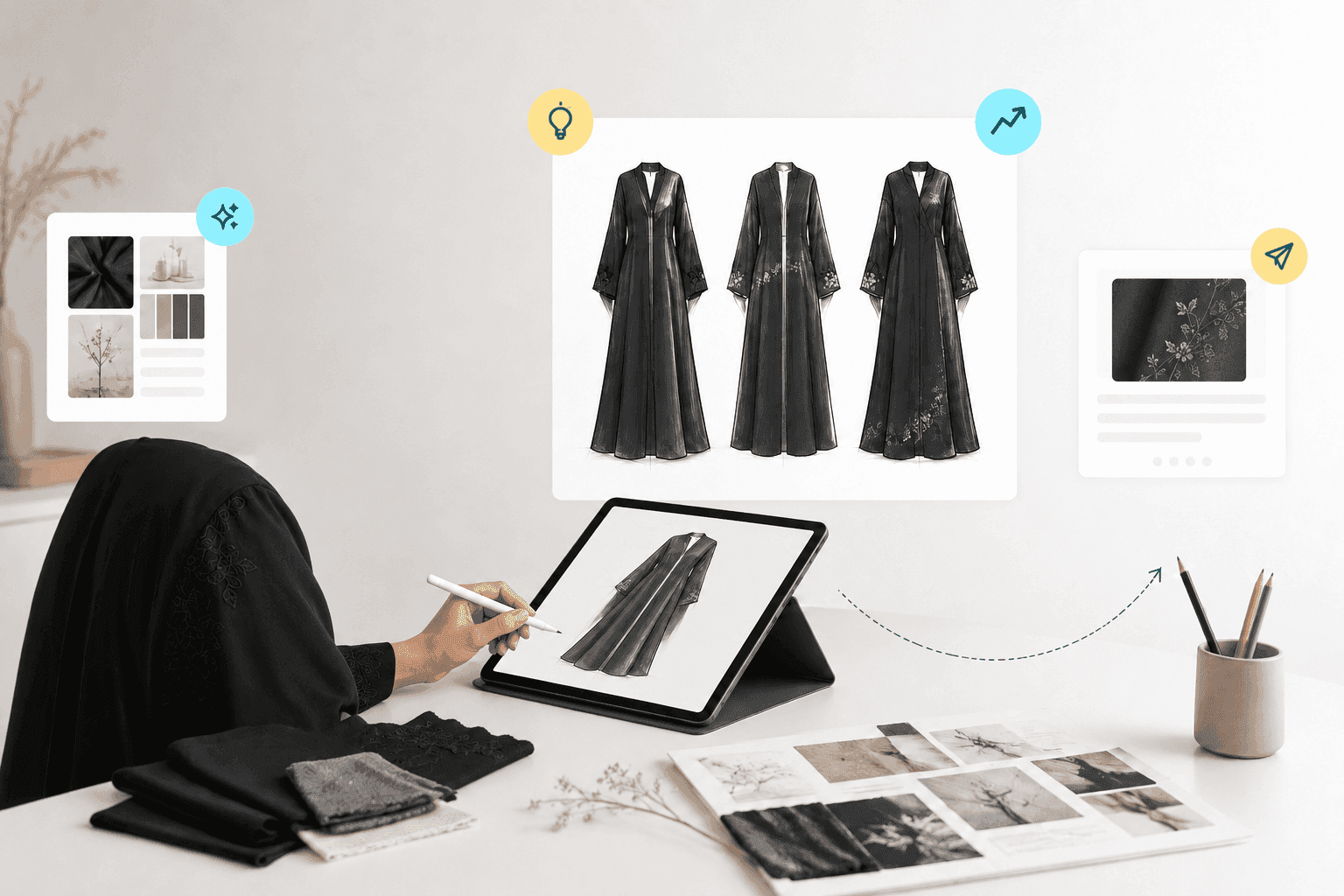
Step One: Turn the abaya idea into a clear drawing and specifications before execution.
Step Two: Choose the fabric and write the abaya specifications
After finalizing the idea, choose the fabric based on use, not just based on looks. A work abaya usually needs a practical and comfortable material, and an occasion abaya may need a different material in drape or details.
Start by visiting wholesale markets and specialized fabric stores in your city. In Riyadh, you can explore known fabric hubs in the Batha area, and in Jeddah, you can start from Al-Balad markets. Before going, search Google Maps for terms like "wholesale abaya fabrics," and "abaya fabric market," and call the store to confirm the location, working hours, and fabric availability.
Take a short list with you when comparing fabrics:
Fabric name or its code with the supplier.
Color and its consistency between batches.
Weight, drape, and transparency.
Does it wrinkle easily? Does it need special care?
Roll width, price per meter, and minimum purchase order.
Availability to provide the same quantity later.
Do not rely on a small sample by sight only. Touch the fabric, test its drape and movement under different lighting, and ask about the washing and ironing method. Then, write a specification card for each abaya including cut, length, sleeve, closure, pockets, embroidery, and every detail affecting execution.
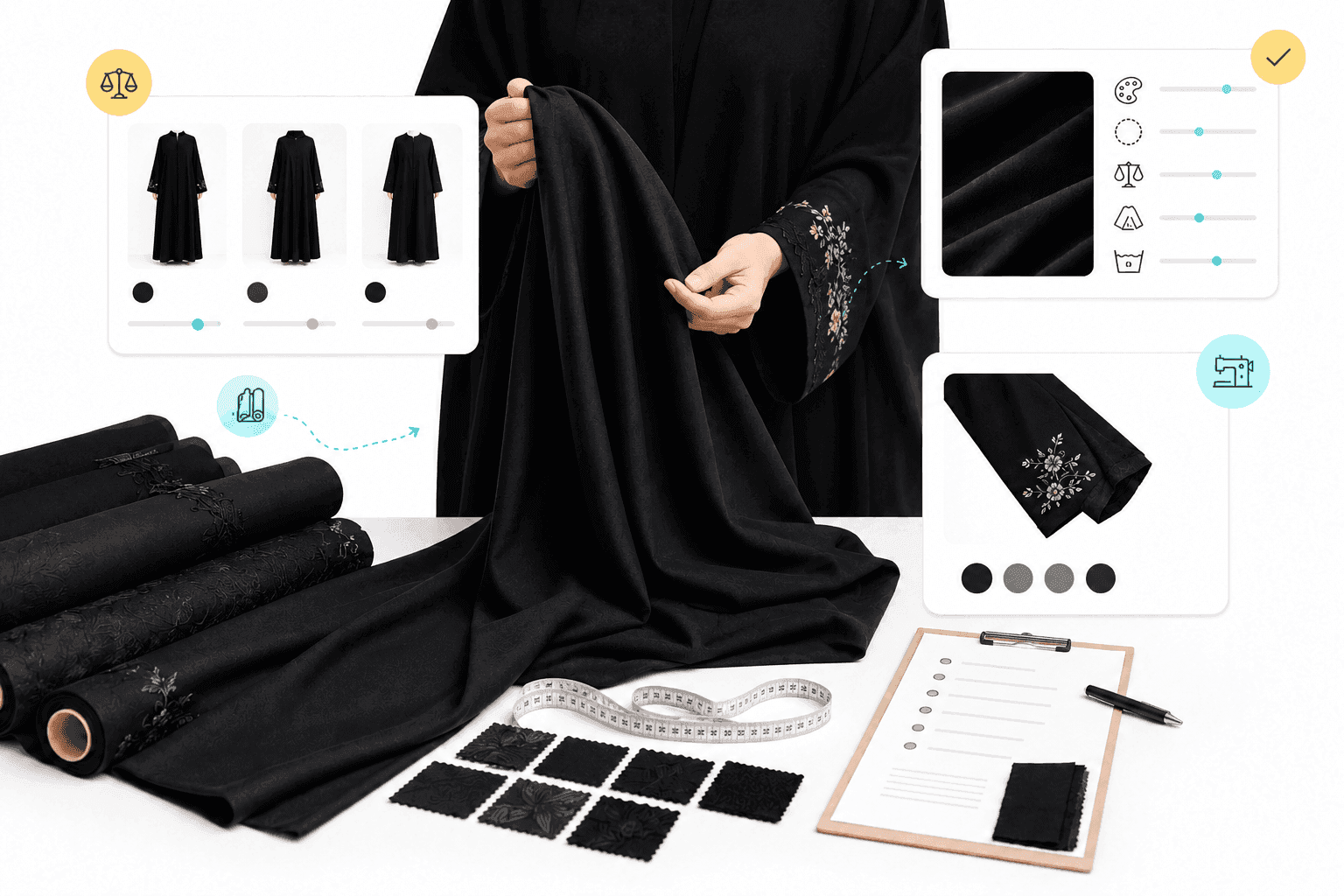
Step Two: Compare materials and record fabric specifications before purchasing the quantity.
Step Three: Choose a suitable abaya tailor or workshop
Take the drawing, specification card, and fabric sample to a tailor specialized in abayas or to a workshop that can execute the quantity you are planning for. You can find nearby options by searching Google Maps for "abaya tailor" or "abaya tailoring workshop," or by asking a tailor you trust for an entity experienced in this type of cuts.
Compare entities based on clear grounds:
Quality of previously executed abayas, especially internal stitching and finishing.
Ability to understand measurements and the specification card.
Sample cost and unit cost after approval.
Minimum order quantity.
Sample execution time and bulk execution time.
Method of handling errors or non-conforming pieces.
Do not start with a large quantity. Request one sample of each design, and write down every agreement in a message or price quotation so that the material, measurements, duration, and cost are clear to both parties.
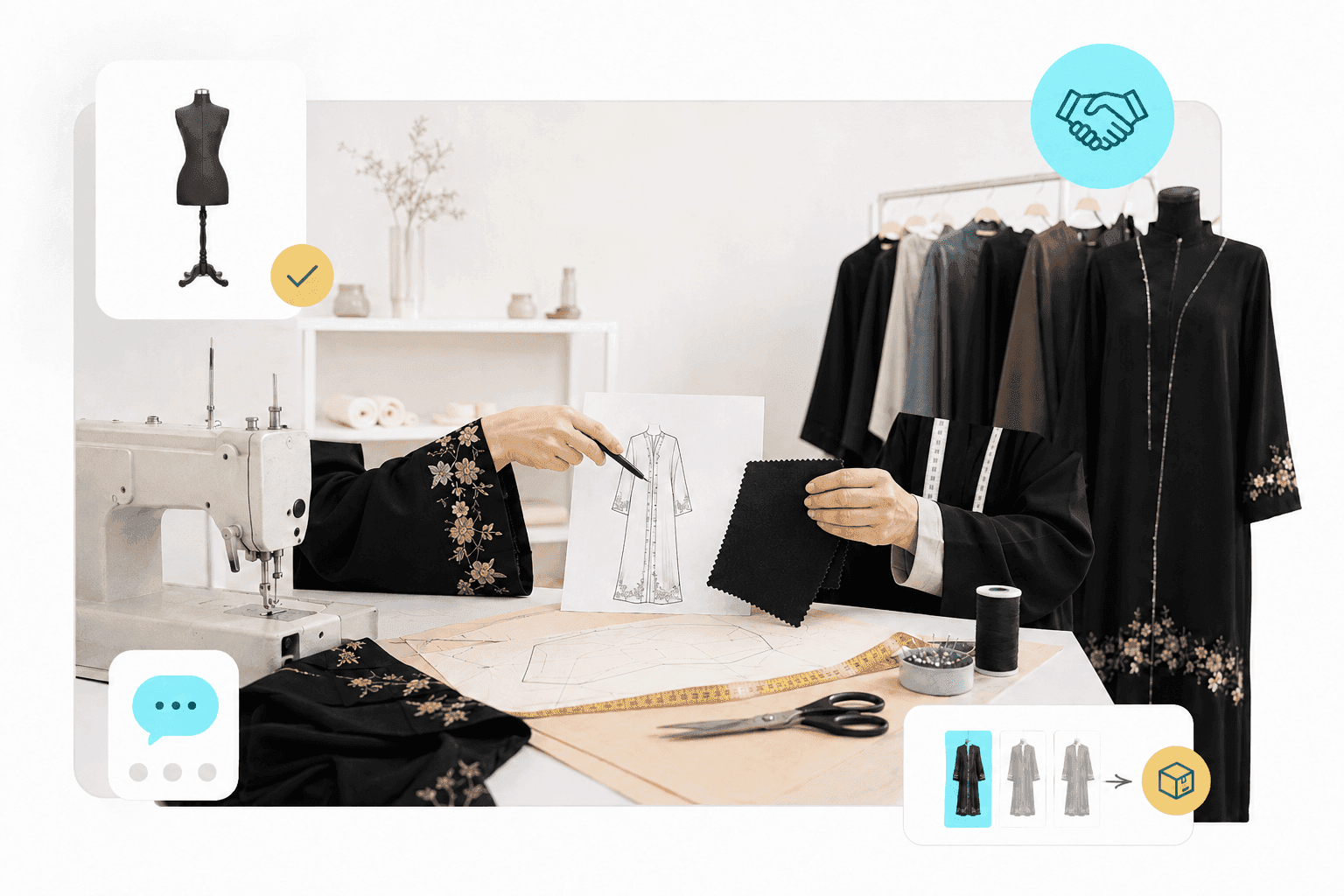
Step Three: Choose an execution party that understands abayas and can commit to specifications.
Step Four: Test the sample and calculate the cost of each abaya
Upon receiving the sample, do not just look at it while it is hanging. Try it in movement and sitting, inspect it under natural light, and then review:
Length, size, and room for movement.
Sleeve length, hand opening, and stability of buttons or snaps.
Straightness of stitching and clean finishing from the inside.
Transparency, shrinkage, and color fastness after care.
Conformity of the sample with the drawing and the specification card.
Record modifications with photos and measurements, and then request a corrected sample if the change is significant. Do not photograph the product or order bulk quantity before approving the final version.
Then calculate the full cost of the abaya, not just fabric and sewing:
Abaya Cost = Fabric + Tailoring + Additions & Embroidery + Product Card & Packaging + Piece share of photography & operation + Expected waste.
Also add the cost of the payment gateway, shipping, or support you bear, and then set a price that leaves a margin covering expenses and allowing the brand to continue. If the cost is higher than the price your target customer accepts, adjust the material, details, or production method before launch.
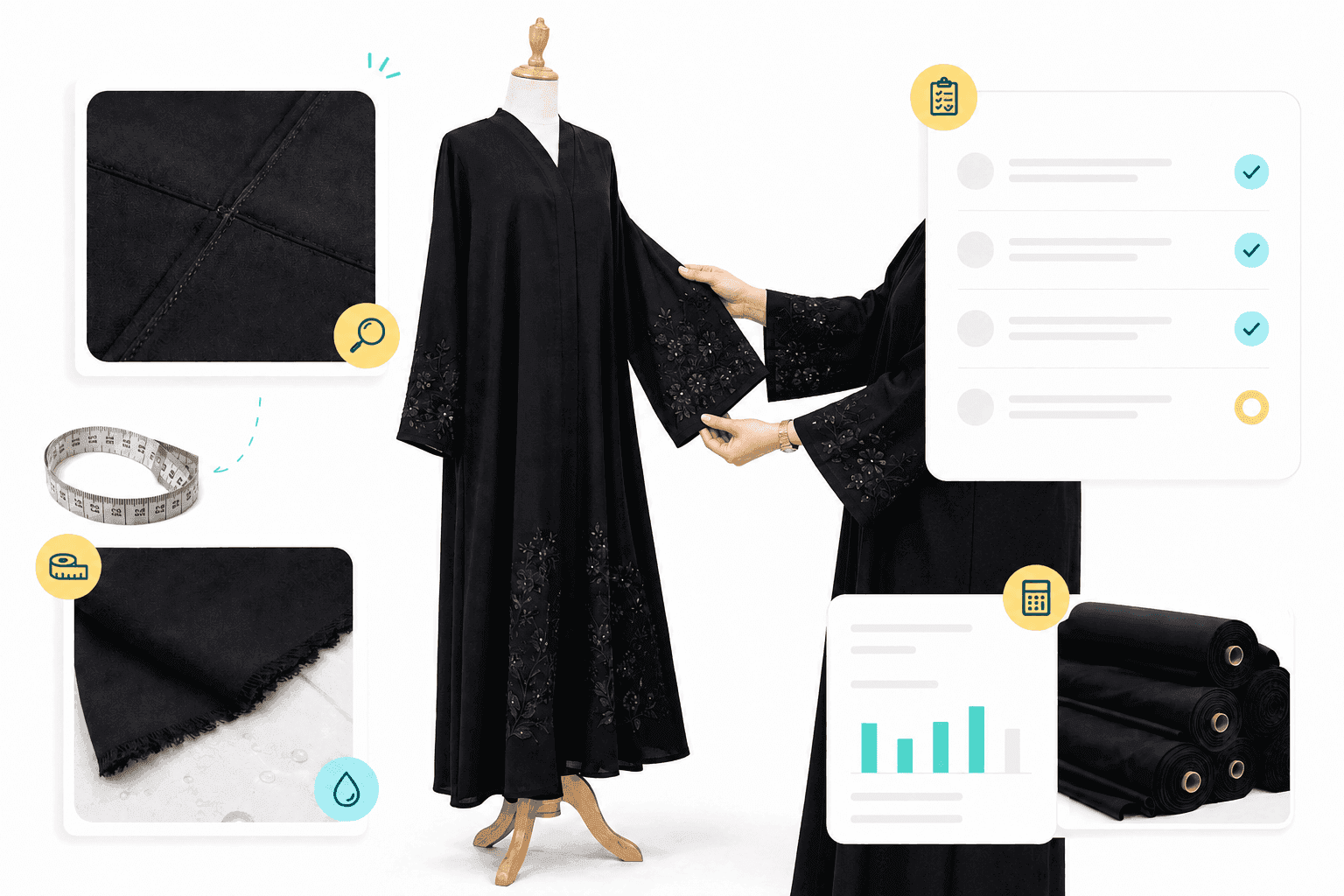
Step Four: Inspect the sample practically and calculate the full cost before approving the collection.
Step Five: Set up the abaya store and launch the collection
After approving the samples, photograph each abaya in a way that shows the cut, material, and details. Avoid relying on a far-off or heavily edited image that changes the actual color.
Each abaya's page must contain:
A clear name for the abaya and a brief description that does not rely on generic phrases.
Front, back, and close-up shots of the material and details.
Lengths, sizes, and how to choose the size.
Fabric type, degree of transparency, and care instructions.
What comes with the abaya, such as the veil (sheila) or belt, if any.
Whether the abaya is ready-made or custom-tailored, and preparation time.
Exchange and return policy presented clearly.
Before announcing, test the entire purchasing journey from your mobile phone:
Open the store from a new link.
Search for the abaya and open the product page.
Choose the length, size, and options.
Add the abaya to the cart.
Enter test customer data.
Select shipping.
Complete payment using an available method.
Make sure the order success message appears.
Review that order details reached both the customer and the control panel.
Review that the size and options appeared correctly in the order.
If the customer needs to contact you to know the size, material, or shipping date, then there is missing information on the product page that needs adjustment before launch.
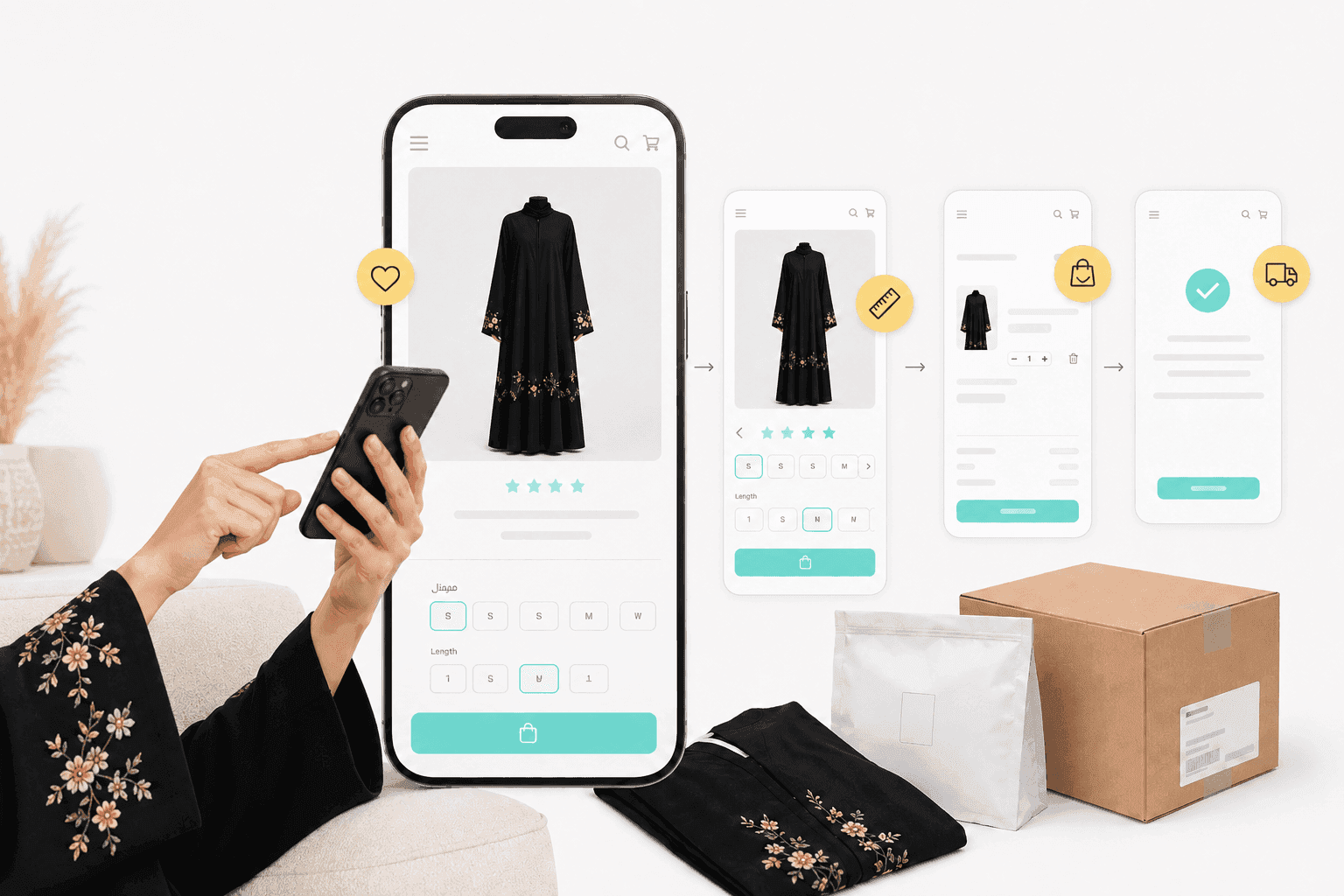
Step Five: Test buying a complete abaya from mobile before receiving orders.
What do you need before launching your abaya store?
A name that is easy to pronounce and write, and can expand with the brand.
A small and coherent collection, and approved samples before production.
Clear cost, price, and preparation time for each abaya.
Accurate photos, description, sizes, and care instructions.
Clear policies for ready-made and custom-tailored abayas.
Payment and shipping methods tested from mobile.
An appropriate quantity for your budget or a clear custom-tailoring plan.
How does Salla help you launch your abaya brand?
Salla's solutions for abaya stores bring together the tools you need to display photos, sizes, lengths, and options, and organize orders, payment, and shipping in one place. Additionally, the Fashion Sector track in Salla clarifies the phases from the idea and product preparation to building the store and achieving the first sales.
If you are in the beginning of your learning journey, the clothing brand establishing course in Salla Academy helps you link the brand's idea with the product and launch steps.
Turn your brand idea into a store ready for sale on Salla
How do you know that the first collection is ready for launch?
The collection is ready when you can explain its idea in one sentence, the samples are tested and approved, the cost is calculated, the sizes and specifications are written, the quantity or tailoring mechanism is known, and the preparation time is clear. After that, the trial order from mobile must succeed without any ambiguous step or missing information.
Common mistakes when building an abaya brand
Starting with the logo before the product: Identity is important, but it does not fix an unclear abaya or inconsistent quality.
Launching a large number of designs: Increases cost and makes it difficult to know what customers prefer.
Buying fabric before testing the sample: You may discover that the material does not suit the cut after buying a large quantity.
Choosing a tailor based on price alone: Redoing work and late delivery may cost more than the price difference.
Pricing the abaya by fabric and tailoring only: This ignores packaging, waste, operation, marketing, and fees.
Launching the store without a test order: The error might show to the customer first in size, payment, or shipping.
Frequently Asked Questions
How many designs do I need to launch an abaya brand?
Usually start with three to five coherent abayas that you can execute and display with consistent quality. The number is not a rule; the most important thing is to learn from actual demand before expanding the collection.
Do I start with design or by choosing the tailor or workshop?
Start with the target customer and the abaya idea, then prepare a drawing and initial specification card. With this information, you can compare tailors and workshops and request a clear sample instead of explaining an ambiguous idea.
Can I design abayas using AI?
Yes, you can use it to build an initial concept and try different trends, but it does not replace measurements, patterns, fabric selection, and a practical sample. The image must be translated into actionable specifications with a designer or specialized tailor.
Do I need an online store from day one?
The store is useful from the beginning because it gathers abaya photos, sizes, policies, and payment in one place, even if the collection is small. It also gives you organized orders instead of collecting sizes, payment, and shipping from scattered chats.
Do I choose ready-made abayas or custom tailoring?
The decision depends on your budget, the uniqueness you want, and the time available for launch. Custom tailoring gives you more control over the design, while ready-made may reduce starting time. In both cases, test quality, cost, and supply clarity before committing.
Useful Sources and Resources
Create your abaya store for free on Salla
Last update: August 2026.
How to Build a Growing Abaya Store? 5 Lessons from the (Al-Alia) Abayas Experience
6 minutes read

Wholesale abayas for businesses and retailers: A guide to building a B2B sales channel
10 minutes read
From Selling on Instagram and WhatsApp to an Abaya Store: A Transition Plan Without Losing Your Customers
10 minutes read
Mohammed Al-Anazi
Product Manager at Salla
49
Article
Featured author

E-commerce
How to Build a Growing Abaya Store? 5 Lessons from the (Al-Alia) Abayas Experience
Al-Alya’s experience shows that growing a fashion store is not just about attracting more traffic. Sustainable growth comes from improving the entire customer journey: reducing hesitation, recovering abandoned carts, offering relevant promotions, simplifying payment, and continuously optimizing the shopping experience.
6 minutes read
Arwa Abdulkarim

Fashion
Wholesale abayas for businesses and retailers: A guide to building a B2B sales channel
Start selling abayas wholesale with a clear offer built for a specific customer segment, including your catalog, order quantities, pricing, samples, and delivery terms. Test demand with a focused approach before expanding your wholesale channel.
10 minutes read
Mohammed Al-Anazi

Fashion
From Selling on Instagram and WhatsApp to an Abaya Store: A Transition Plan Without Losing Your Customers
Maintain your accounts and relationship with female customers, and gradually transition abaya selection, payment, and shipping address to the store. Start with clear products and test demand before expanding the launch.
10 minutes read
Mohammed Al-Anazi
Fashion
How to move your abaya shop online and manage inventory for both channels together?
Start by auditing every model, size, and color, and unifying the codes; then test the integration of the cashier and the store, as well as the cancellation and exchange procedures. Expand after stabilizing inventory and fulfillment.
11 minutes read
Mohammed Al-Anazi