25 min read

Arwa Abdulkarim
Product Marketing Manager
Would you like to read a summary of the article?
Summarize with ChatGPT
Summarize it with Claude
Summarize it with Perplexity
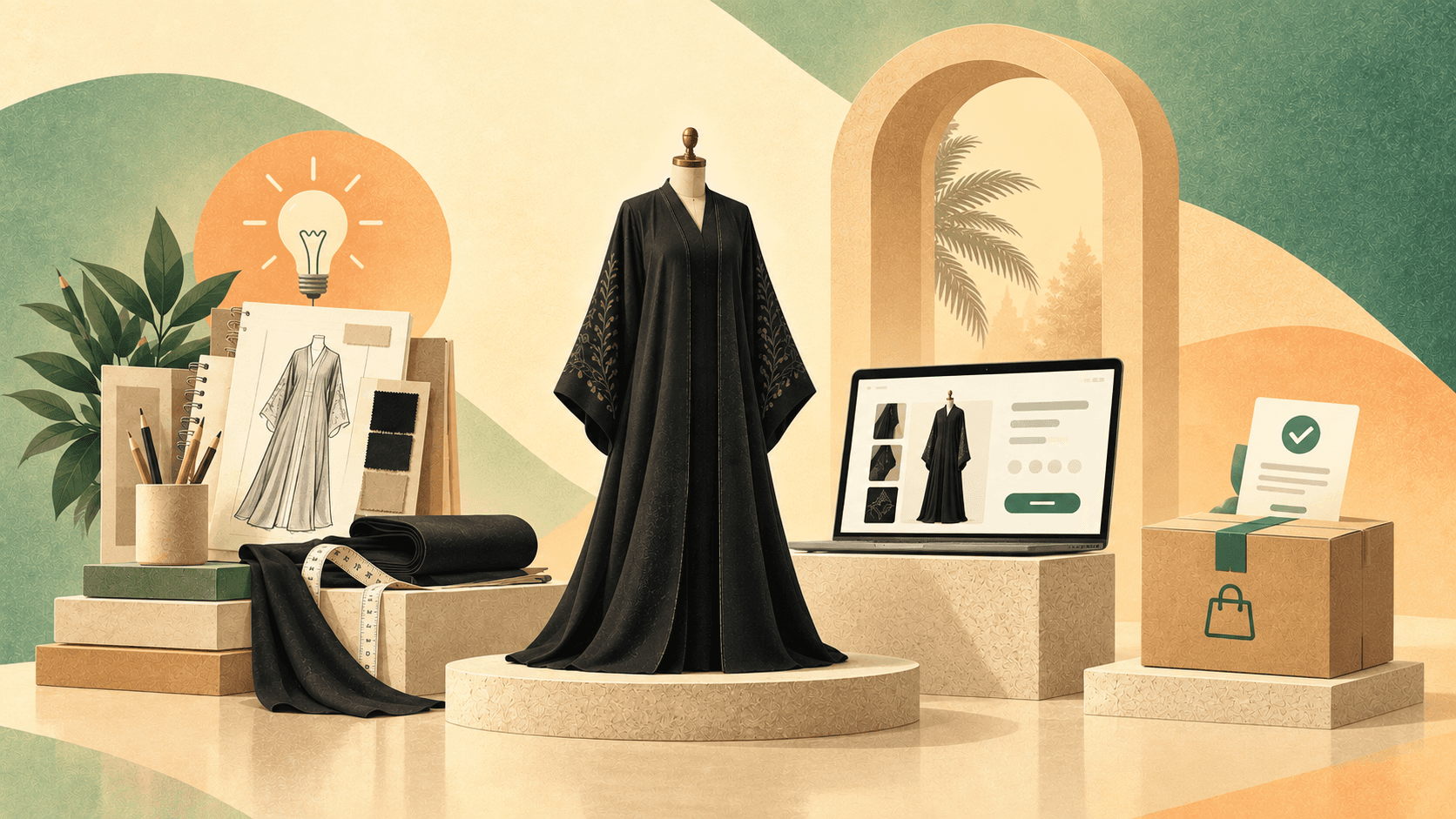
An abaya business idea may start from something very small. An abaya you saw and said its cut could have been more beautiful, a fabric you know and trust, a design you drew some time ago, or even a recurring observation whenever you search for an abaya for yourself or those around you: why does no one make it this way?
At the beginning, the idea seems fun. You save the pictures, imagine the name and packaging, and see the entire brand in your head before the very first abaya even exists. Then the real questions begin: where do I get the fabric? Do I deal with a tailor or a factory? And how many pieces do I order? What if the factory demands a large quantity? Do I start with ten abayas or fifty? And if I choose a model and it doesn't move, what do I do with the inventory? How do I determine the sizes and lengths? How much will photography cost? And how do I price the abaya after all these costs?
Then you open Instagram and see dozens of abaya stores that look as if they started years ahead of you, so the question turns from (How do I start?) into a much heavier question: Does the market even need me?
These are not imaginary fears of an abaya merchant. In our interviews with merchants actually working in the sector, competition, continuous renewal, customer acquisition cost, design and manufacturing, sizes and lengths, and inventory management emerged as real parts of the difficulty of this type of business. Even reaching the product itself may go through a long journey of developing the idea, coordinating with the designer or factory, executing the sample, reviewing it, and then modifying it until it reaches the desired form.
Therefore, we will not tell you: do not be afraid, open a store and everything will become easy. Opening a store is not even the hardest part of an abaya business. The hardest part is knowing what you will sell, to whom, how much you can risk in your first experience, and how to make someone who has not touched the fabric or tried the abaya in front of a mirror trust what they see on the screen enough to order it.
And this is what we will build in this guide, step by step, from the first idea to the first order.

Before you ask: How do I open an abaya store? Ask: What will I actually sell?
One of the most tempting things when starting an abaya brand is to start with the brand itself: the name, logo, colors, packaging, the look of Instagram, and the theme that the store will carry. All of these things are important in their own time, but the customer will not buy the identity alone. In the end, she will stand in front of an abaya and ask herself: Do I like it? Does it suit me? Is its fabric good? Can I find my length and size? And is it worth this price?
Therefore, the first question may be simpler than building the entire brand: What is the first abaya I can put in front of a customer and learn from her reaction?
It could be an abaya you designed yourself, a model you developed with a designer, a product you can get from a supplier, or a piece from your already existing collection if you sell in a physical store and are thinking of moving online. It does not matter if the beginning looks big; what matters is that you have something clear that you can test.
Do I need a large collection to start an abaya business?
Not necessarily. Having twenty models may make the brand look bigger, but it also means twenty decisions in design or sourcing, and more products that need photography, descriptions, sizes, lengths, and options, and perhaps a larger inventory before you even know what customers want.
A logical fear may appear here: (Well, what if I start with a small quantity and it runs out quickly?). But the question has another side that is also worth thinking about: What if I start with a large quantity and it doesn't move?
In the beginning, do not look for the quantity that makes you look like a big brand, but rather for a quantity that gives you a real opportunity to sell and learn, without making the first decision you make bigger than your ability to bear its mistake. The first collection is not a final exam for your project; it is the first question you ask the market.

The market is full of abayas... What will make someone buy from me?
This fear is real. Some merchants we met talked about the pressure of price competition, the constant need for renewal, and stores that can sell at a low price while the merchant tries to maintain fabric and quality that increases their cost. Therefore, there is no use in saying that competition does not exist; it does, but its existence does not mean that all stores offer the same thing to the same customer in the same way.
Your place in the market may be in a different design, a cut that suits a specific use, a fabric you chose carefully, sizes and lengths that the customer cannot find easily, a level of quality you want to maintain, or a shopping experience that makes understanding and choosing the product easier. And being different does not mean inventing an abaya that the world has never seen before; sometimes being different is simply that you understand your customer more accurately, and build what you sell around what she needs.
There is a big difference between saying: (I want to sell abayas), and knowing: Which abayas do I want to sell? To whom? And why would this customer choose me among all the options in front of her?
From design to abaya: Where does the starting budget go?
In abayas, the cost does not always start when you buy the ready-made piece. There may be an entire journey before you even have a product you can photograph: an idea, a design, a fabric, a designer, tailor, or factory, a first sample, a modification, another sample, and then the production quantity. One of the merchants we met described this journey itself as one of the most time-consuming and effort-consuming processes in their business.
Here, one of the big fears in the beginning appears: How much capital do I need?
There is no single answer that fits every abaya business, because the business model itself changes the number. Someone who designs and produces is not like someone who buys a ready-made product, and someone who starts with a limited collection is not like someone who prepares a large inventory, and someone who photographs themselves is not like someone who produces a full photography campaign. So instead of starting with a general number and building your project around it, start by breaking down what you will actually pay for.
What is the cost of developing the first product? How many pieces do you need to produce or buy? What will it cost to prepare, photograph, and package them? And how much of the capital will remain stuck in inventory if the product does not move as fast as you expected?
These questions may seem less exciting than choosing the brand name, but they protect the idea you were excited about in the first place.
How do I price the abaya without losing money while selling?
After the cost of the product becomes clear, comes the question that seems simple until you try to answer it: For how much do I sell the abaya?
Your first instinct might be to open competitors' stores. An abaya close to your design for 250 SAR, another for 320, and a store selling for 180. After several comparisons, you choose a number that seems suitable for the market. But there is a problem: you know the competitor's price, but you do not necessarily know how they reached it.
Their cost might be lower, they might order larger quantities, they might have a different supplier, they might accept a lower margin, or they might rely on an entirely different business model. Or they might simply be pricing in an unhealthy way as well. In our interviews, merchants talked about this specific pressure; competing with low prices becomes harder when the cost of the fabric and quality you want to maintain is higher.
Therefore, start with your own cost. Calculate the cost of buying or manufacturing the abaya, samples and modifications when they are part of its development process, packaging, costs associated with preparing the order, and any cost you bear until the product is ready for sale. And if you do a large part of the work yourself, do not treat your time as if it is free just because you did not pay a bill to yourself.
After that, you can ask: Does the price cover my cost? Does it leave a margin that makes selling feasible? And is the value the customer sees logical for this price? Then go back to the market to know where you stand, not to let the market alone decide how much you should sell.
The competitor's price is a number you see, but you do not know their cost.

The idea here is not to raise the price unreasonably, but to avoid a scenario that could be more dangerous than a lack of orders: that orders increase while you lose money with every abaya you sell.
How do I make the abaya purchasable online?
In a physical store, the customer can touch the fabric, see the cut, try on the abaya, stand in front of the mirror, and then ask the employee about any detail she did not understand. Online, you are asking her to make the same decision from a screen.
Here, there is a gap that the product page must fill.
In our interviews with abaya merchants, sizes, lengths, and the difference in cut from one model to another emerged repeatedly as a sensitive part of selling. One merchant pointed out that a single size chart does not necessarily work for every abaya because the cut, length, and how the piece is worn may differ, while others talked about the high volume of customer questions about sizes and the importance of photos and video in making the product clearer before purchasing.
Therefore, it is not enough to upload three beautiful photos and write the name and price of the abaya. Ask yourself: What would the customer do if this abaya were hanging in front of her in the store? And how do I give her the closest thing possible to this knowledge through the screen?
Photography costs me... but how do I sell an abaya that cannot be seen correctly?
An abaya is a visual product, but this does not mean that the first photoshoot needs to be a huge campaign. Before thinking about the location, decor, and big production, ask about the function of the photo itself: What does the customer need to see to understand the abaya?
She needs a full photo showing the cut, closer shots of important details, a photo that helps understand the fabric and color, and perhaps a short video when the movement and drape of the fabric are part of what a static photo cannot convey. One of the merchants we met specifically pointed to the value of video in helping the customer understand the shape of the abaya better.
The goal of photography in the beginning is not to make your project look bigger than it is, but to make the product understood as it is.

What do I write in the abaya description?
Before you write "unmatched elegance" or "a design that captures attention," define the abaya. What is the fabric? What is the cut? What is the color? What are the distinctive details? What are the lengths, sizes, or options available? Does it come with anything extra? And are there care instructions the customer needs to know?
The model can carry a beautiful name that fits the brand's personality, but do not make the creative name the only information the customer sees. "Layali" might be a beautiful name, but "Layali - black wide-cut abaya" adds information that helps her understand. The name builds personality, and clarity helps with the decision, and we do not need to sacrifice one for the other.
And think of the description, photos, and sizes together as an answer to one question: Can the customer know what she will buy without needing me to be next to her to explain it?
Size is not a detail... it might be the moment the purchase process stops
The customer may like the abaya, be convinced of its price, and then stop at a simple question: (Which length do I take?). And if she does not find a clear answer, the desire to buy may turn into a direct message, a delay, or leaving the store entirely.
Therefore, it is not enough for sizes and lengths to be there; the customer must be able to understand them and choose between them with confidence. And if the cut of a specific model differs from others, it is better for her to know that before ordering, not after it arrives.
Every question you answer before buying reduces the space for guessing after it, and this does not only help complete the order; it also helps make the customer's expectation closer to what will actually reach her, which is important in a sector where sizes, cut, and fabric are reasons for hesitation, exchange, and return.
I sell abayas on Instagram and WhatsApp... Do I need an online store?
You might not be in the idea stage at all. Perhaps you have the products, the photography, the account, and the followers, and you actually get orders. But almost every order starts the same way: (How much?), (Is length 54 available?), (Is there a clearer picture?), (How is the fabric?), (How do I order?). Then you start gathering details, checking availability, sending payment information, and following up on the order.
In the beginning, this might be normal. The beautiful problem starts when the account succeeds, because every new order does not come alone; it brings with it more messages, questions, and follow-ups. In our interviews with abaya merchants, this journey actually appeared; selling via WhatsApp and Instagram meant replying manually to price, size, availability, photos, and payment, and some merchants needed more than one employee to follow up on orders this way. After moving to an online store, the customer became able to see the information, complete the order, and pay without waiting for a reply at every step.
Here, the role of social media changes, it does not disappear. Instagram can remain the place where the customer discovers the brand, sees the abaya for the first time, and watches stylings and content, while the store becomes the place where she finds the product, price, photos, sizes, and availability, and chooses, pays, and completes the order.

I have a physical abaya store... Is e-commerce right for me?
And there is a completely different third starting point: you have a store, products, inventory, customers, and perhaps years of experience in the sector. You are not asking how to start an abaya business, but how to make your business exist also when the customer searches and buys online.
One of the experiences we encountered started from a physical store and continued in it for nearly three years, then she noticed a change in customers' behavior and their greater direction toward buying online, so she closed the store and moved to e-commerce. What is interesting about her experience is that the move did not lead, according to her conversation, to an immediate huge jump in sales; the value was that her business became present in the place where the customer moved.
And this does not mean you need to close your physical store. The most useful question might be: How do I make the physical store and the online store complement each other instead of managing two separate experiences? The customer might see the abaya on Instagram, order it from the store, or buy from the branch or an event. To her, these are all the same brand, and the more you can organize products, inventory, and orders between different points of sale, the simpler the experience becomes for both of you. This need also appeared in industry interviews, including using POS to manage sales in the physical store and events and linking it to online commerce.
When do I need to open an online abaya store?
Not when everything becomes perfect, but when you have something clear enough to sell, and you need a place where the customer can understand the product, choose what suits her, and complete the order and payment without the entire journey depending on your presence on the other side of the conversation.
The first store does not need dozens of models or a complex design. It needs to clearly answer the customer's basic questions: What is this abaya? How does it look? What is its fabric? How much is it? What are the sizes, lengths, and options available? How do I order? How do I pay? And how will it reach me?
If you now know what you want to sell and are ready to turn the idea into a place that receives orders, you can create an online store for free, and start with the first ready-made abaya instead of waiting for the full collection.
In the video, we move from idea to application on an actual abaya store: creating the store and preparing the design, then adding an abaya with photos, name, price, description, options, sizes, lengths, and quantities, and preparing shipping and the rest of the elements that the product needs to become ready for sale.
But do not treat adding the product as just a data entry process. Build the page from the customer's eye: when she sees the first photo, what question is in her head? And when she reaches the price, what does she need to know about the value? And when she reaches the options, does she know what to choose? And if she reaches the buy button, is there a basic question left unanswered?
A good product page does not just display the abaya; it helps the customer make the decision.
How do I know that the abaya store is ready for the first customer?
There is a difference between (my store is not ready to sell) and (my store is not complete). Unclear sizes may prevent the order, the lack of a payment or delivery method prevents it, and photos that do not clarify the abaya may make the customer hesitate. As for the fact that you have not added the next collection, or have not yet reached the final design you imagine for the store, it does not necessarily mean that you are not ready for the first sale.
Try a simple test. Give the store link to someone who did not participate in building it and tell them: (Choose an abaya and try to order it, and don't ask me any questions). Then do not help them. If they stop at the length, review the explanation of lengths. If they do not know the size, review how sizes are presented. If they cannot understand the fabric or the cut, review the photos and description. And if they reach the end of the journey and do not know how or when the abaya will arrive, review the delivery information.
And do not just ask: (Did you like the store?). Ask: Where did you hesitate? What information did you look for? And what question were you about to ask me?
This last question is very important, because every question that would have taken the customer out of the store to the DM may reveal something you can make the store answer next time.
After modification, execute a full trial order from mobile. Enter as if you are a customer who does not know the business, choose an abaya, specify the options, add it to the cart, and complete the checkout journey. If the customer can understand what you sell, choose what suits her, know the price, and complete the order and understand what will happen next, you have reached something important: you have a store that can receive the first customer. Not the final version, but the version you need to start.
How do I get the first order in the abaya store?
Here, the fear that appeared at the beginning of the article returns in a new form. You spent on the product, photography, and store, and now the question is: What if no one buys?
Do not start by trying to reach everyone who buys abayas in Saudi Arabia. Start with whoever is closest to what you sell. It could be a follower who previously asked about a similar product, a customer you know buys this type of abayas, a person who liked a previous design, or your physical store's customers if you are moving from direct selling to online. And if you already sell via Instagram or WhatsApp, you are not starting from scratch; you have people who know your products and maybe bought from you before.
Start with a small group of people who have a real reason to be interested, then watch what they do, not just what they say. The phrase "it's very nice" is beautiful, but it differs from "how much?", "is my length available in it?", and "when does it arrive?", and it differs even more from a person who reached the payment page and completed the order.
The goal of the first attempt is not to prove that the brand will succeed for years. The goal is to make the idea collide with the market for the first time.
Do I need ads from the beginning?
Not necessarily. Advertising can expand reach, but it does not automatically fix an unclear product or a page that does not answer the customer's questions. And before you pay to make thousands of people see the abaya, it is useful to learn from what happens when the first small number of appropriate people see it.
Did they click on the product? Which model attracted them? What questions were repeated? Did they ask about the price a lot? Is the hesitation in the size? Do people enter and not complete the order? This is information that helps you improve the product, page, or offer before you pay to enlarge the same problem.
This is especially important because customer acquisition costs and advertising competition appeared among the challenges of the abaya merchants we met.

The first abaya order has arrived... What next?
Congratulations, and live the moment for a bit. Because what happened may seem very small on the orders dashboard, but it is big for the idea you started with: the first customer entered the story.
In the beginning, there was an abaya in your head, a sketch, a fabric, an Instagram account, or a physical store you wanted to take to a new place. You went through the questions of the supplier, factory, inventory, cost, photography, sizes, and price, then you put the product in front of a person who does not know all these details you lived.
Despite that, she chose to pay for it.
This does not mean that the business succeeded permanently, nor that this model will become the best-seller, nor that future orders are guaranteed. But it means something important: you are no longer just imagining how the market will behave; you have its first real action.
Therefore, do not move directly from the first order to the question: How do I reach 100 orders? Start with the order in front of you. Which abaya did the customer choose? Which length and size? Where did she arrive at the store from? Did she ask anything before buying? Did she find what she needed easily? And did the abaya arrive as she expected?
Then monitor the following orders. You might discover that a model you thought was secondary is the one moving, or that a specific length is repeated, or that one question arrives from almost every customer, or that the fabric photos need to be clearer, or that a product is viewed by everyone and bought by no one.
These are not small details after success, this is the material from which you will build the next version of your business.
From an abaya business idea to a real business
Perhaps you started this article carrying a long list of things you believe you need to solve before you start: the perfect factory, the complete collection, the larger capital, the photoshoot you imagine, the brand identity, dozens of models, and the inventory that covers all possibilities.
But the beginning does not need to answer every question your project will face in the coming years. It needs to answer the next question enough to make you move.
What is the first abaya I test? Who might buy it? How much does it actually cost me? How do I make it clear on the screen? What is the price that allows me to sell without hurting the business? How can the customer order it? And what do I learn when that happens for the first time?
This is how the idea turns from a beautiful thing in your head into something that the market can see, choose, and judge.
And the first abaya may not be the best-seller. You may adjust the price, change the photos, discover that the sizes need better explanation, and rethink a model you were sure of. And maybe this is exactly the best thing that can happen in the beginning; because you learn with this information now, instead of learning it after you manufactured a large quantity and built bigger decisions on assumptions you did not test.
If you are still in the stage of (I have an idea, but what is the next step?), then the starting guide from idea to first order organizes the journey for you based on where you start, whether you are starting with an idea, selling via social media platforms, or have a physical store and want to transition to e-commerce.
And if the product has become clear and you are ready to put it in front of the first customer, you can create an online store for free and start with what you have today.
Because an abaya business does not need to look complete to start; it needs to reach the moment when what was in your head becomes something that someone else chooses and pays for.
Frequently Asked Questions about Starting an Abaya Business
How do I start an abaya business from scratch?
Start by determining the type of abayas you want to sell and to whom, then test a product or a limited collection before expanding inventory. Calculate the full product cost, and prepare it with clear photos and information about the fabric, cut, sizes, lengths, and price, then create a path through which the customer can complete the order and payment. The goal in the beginning is not to build a complete brand, but to reach the first sales experience you can learn from.
How do I start an abaya design business?
If you are going to design the abayas yourself, start by identifying the customer you are designing for and the problem or desire that the design wants to serve, then turn the first idea into a sample you can evaluate before producing a large quantity. Calculate the cost of sample development and production, and test the product in the market before expanding the collection. Design is the beginning of the product, but the customers' response is what helps you know what is worth developing next.
How much capital do I need to start an abaya business?
There is no single number that fits every abaya business; the cost varies depending on whether you design and produce or buy ready-made products, the size of the first quantity, and the cost of materials, photography, packaging, and operation. Therefore, it is best to calculate the cost of the first experiment you want to launch instead of starting with a general number that does not reflect your business model. As for the feasibility study and detailed costs of the abaya project, they deserve a separate, more detailed guide.
Do I need to design the abayas myself?
Not necessarily. The project can rely on your design and production, or on products you obtain from a supplier or factory. What is important is that you know the source of the product, your ability to provide it with the expected quality, its real cost, and why the customer would choose it from you. As for choosing factories, suppliers, and wholesale purchasing, it is an independent topic that needs a deeper treatment than a short answer.
Do I need a large inventory to start?
Not necessarily. Starting with a limited collection can reduce the amount of capital tied up in products you have not yet tested the demand for, and gives you a chance to know the models, sizes, and lengths that customers are interested in before expanding. The appropriate inventory size depends on your production model, the minimum quantity required by the supplier or factory, and your ability to restock the product.
Do I sell abayas via Instagram or open an online store?
Instagram can be a strong channel for brand discovery and displaying products and content, while the online store helps organize product details, sizes, options, customer data, payment, and delivery in a journey that the customer can complete themselves. Therefore, you do not have to choose one and leave the other; social media can attract the customer, and the store can complete the purchase process.
How do I open an online abaya store?
After preparing the first products, add the abayas with clear photos, names, descriptions, prices, sizes, lengths, and options, then set up payment and delivery and test the entire order journey from mobile before sending the store link to customers. You can create an online store for free then apply the steps in the abaya store tutorial inside this guide.
How to Build a Growing Abaya Store? 5 Lessons from the (Al-Alia) Abayas Experience
6 minutes read

Wholesale abayas for businesses and retailers: A guide to building a B2B sales channel
10 minutes read
From Selling on Instagram and WhatsApp to an Abaya Store: A Transition Plan Without Losing Your Customers
10 minutes read
Arwa Abdulkarim
Product Marketing Manager
11
Article
Featured author

E-commerce
How to Build a Growing Abaya Store? 5 Lessons from the (Al-Alia) Abayas Experience
Al-Alya’s experience shows that growing a fashion store is not just about attracting more traffic. Sustainable growth comes from improving the entire customer journey: reducing hesitation, recovering abandoned carts, offering relevant promotions, simplifying payment, and continuously optimizing the shopping experience.
6 minutes read
Arwa Abdulkarim

Fashion
Wholesale abayas for businesses and retailers: A guide to building a B2B sales channel
Start selling abayas wholesale with a clear offer built for a specific customer segment, including your catalog, order quantities, pricing, samples, and delivery terms. Test demand with a focused approach before expanding your wholesale channel.
10 minutes read
Mohammed Al-Anazi

Fashion
From Selling on Instagram and WhatsApp to an Abaya Store: A Transition Plan Without Losing Your Customers
Maintain your accounts and relationship with female customers, and gradually transition abaya selection, payment, and shipping address to the store. Start with clear products and test demand before expanding the launch.
10 minutes read
Mohammed Al-Anazi
Fashion
How to move your abaya shop online and manage inventory for both channels together?
Start by auditing every model, size, and color, and unifying the codes; then test the integration of the cashier and the store, as well as the cancellation and exchange procedures. Expand after stabilizing inventory and fulfillment.
11 minutes read
Mohammed Al-Anazi