17 min read

Mohammed Al-Anazi
Product Manager at Salla
Would you like to read a summary of the article?
Summarize with ChatGPT
Summarize it with Claude
Summarize it with Perplexity

You might find a fabric you like at first touch: beautiful color, soft texture, and a reasonable price. But after turning it into an abaya, you may discover that it is shear under daylight, wrinkles quickly, does not drape the way you imagined, or that the embroidery causes it to sag on the sleeve side.
This is why choosing abaya fabrics is not just a buying decision, but part of designing the product itself. The fabric affects the cut's shape, customer comfort, how it is photographed, care for the piece, its production cost, and even the likelihood of it being returned.
If you are at the beginning of your abaya business, the most expensive mistake is not buying high-priced fabric, but rather buying a large quantity of a fabric you haven't tested enough, or buying a material linked to a season or trend in a quantity greater than you can sell during its demand period.
It is best for the material to go through several clear decisions: determine what the abaya needs, find out if the material is permanent or seasonal, then test an actual sample and calculate its cost, and after that, start with a limited quantity before committing to a larger amount.
Start with the use of the abaya, not the name of the fabric
Before going to the fabric market or contacting the supplier, refer to the design and ask: when will this abaya be worn?
A work abaya, for example, often needs a material that withstands frequent use, is comfortable to move in, relatively wrinkle-resistant, and easy to care for. As for travel abayas, lightness, ease of folding, and wrinkle resistance might be more important. For occasion abayas, the drape of the fabric and its ability to hold embroidery or details may become a major part of the decision.
Even the cut changes what you need from the material. A wide cut made of heavy fabric may become tiresome when worn and consume a larger amount, while extremely light fabric may not give the required shape for a cut that needs a clearer structure or stiffness.
So do not start by asking the supplier: "What is the best fabric for abayas?". It is better to first know what you need from the fabric, and when you expect to sell it.
Is the material permanent, seasonal, or trend-related?
This point is important before buying the quantity, because the suitable material for the design is not necessarily suitable for the inventory you want to maintain.
Ask yourself: is this a basic material you can use all year round? Or a light summer material that you need more of in hot months? Or a heavier material for the winter collection? Or is its appeal linked to a color, texture, or trend currently widespread, and demand for it might change quickly?
Permanent material gives you more space to build basic products around it and reproduce them, especially if the supplier can provide it consistently. Over time, it may become a permanent part of the brand that you use in more than one design and collection.
As for seasonal materials, you need to link the purchase quantity to the launch date of the collection and the duration of the season. Getting an excellent wholesale price does not benefit you if a large portion of the quantity remains after the period you planned to sell in ends.
Trend materials require greater caution. A color, texture, or type of fabric can spread quickly, but buying a large quantity based on current popularity might leave you with stock that is difficult to use if the trend changes. In this case, limited production and then reordering according to sales might be better than committing to a large quantity from the start.
There is an important question for the supplier: is this material among your continuous items, or is it a seasonal or limited batch that may not be repeated? Because the success of the abaya may push you to reproduce it, and then you need to know if you can get the exact same material in the same color and specifications.
Think of the material from four aspects together: use of the abaya, the season, the lifespan of the trend, and the continuity of supply. In this way, your decision becomes not just "Is the fabric beautiful?", but "Is it a good buying decision for this collection and at this time?"
6 things to test in any abaya fabric
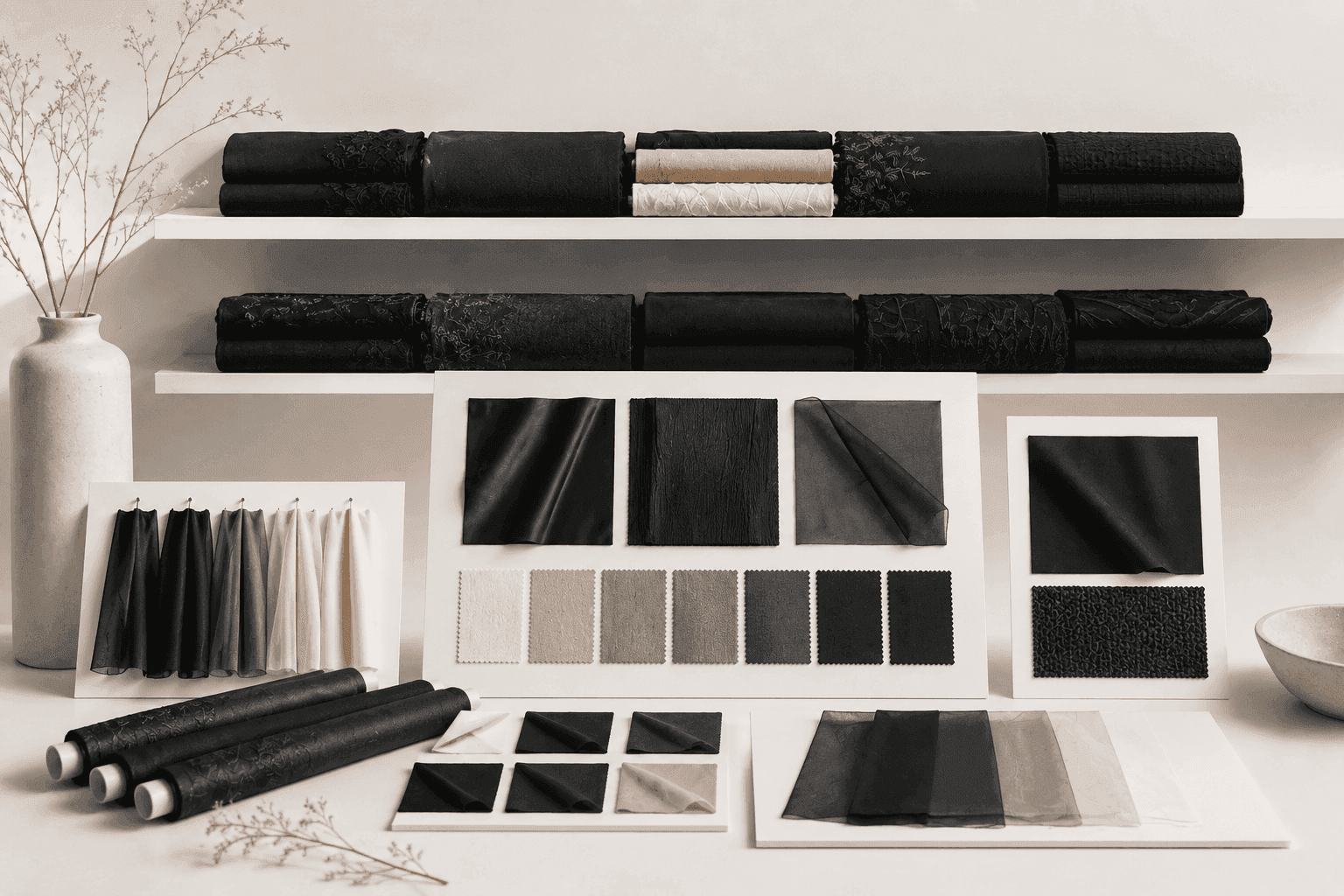
Compare materials by weight, drape, transparency, and care.
When comparing materials, do not rely on the trade name alone. Focus on six practical properties.
Weight: Hold the fabric and try it in a quantity close to what will go into the abaya, because a small piece may look light while the weight of the full abaya becomes different.
Drape: Hang the fabric or place it on an elevated surface and look at how it falls. Does it move softly or retain a clear stiffness? There is no always correct answer; the requirement is that it suits the cut you want to execute.
Transparency: Do not test it only under shop lighting. Place the sample in daylight and try it over light and dark backgrounds, because some fabrics look opaque indoors and then change under the sun.
Wrinkling: Squeeze a part of the fabric for several seconds then release it. Observe how quickly it returns to its shape, especially if you are developing an everyday or travel abaya.
Durability and appearance stability: Observe what happens to the surface with friction, washing, and use. Does pilling appear? Does the color change? Does the fabric lose its texture or shape quickly?
Care: Ask how it is washed, ironed, and preserved. A beautiful material that requires exhausting care may not be suitable for a piece you present as a practical, daily abaya.
The name of the material alone is not enough
You will hear many names for abaya fabrics in the market, and you may find the same supplier offering more than one grade under the same name. Therefore, do not assume that buying a material carrying the same name from another supplier will give you the same result.
Composition, weight, width, texture, color, finish, and even batch can differ from one supplier to another.
For this reason, from day one, give each sample your own internal code. Instead of writing "black fabric No. 3", use a code like FAB-001, for example, and link it to the supplier's name, supplier code, color, width, price, purchase date, and batch number if available.
Also record with it whether the material is permanent throughout the year, seasonal, or linked to a trend, and whether the supplier informs you that it is continuously available or comes in limited batches.
After several months, when a certain abaya succeeds and you want to produce it again, you will know exactly which material you used instead of returning to the market with a mobile photo trying to remember the fabric.
Do not buy the material before testing a sample of it
If you like a new material, take a suitable sample for testing before buying the production quantity whenever possible.
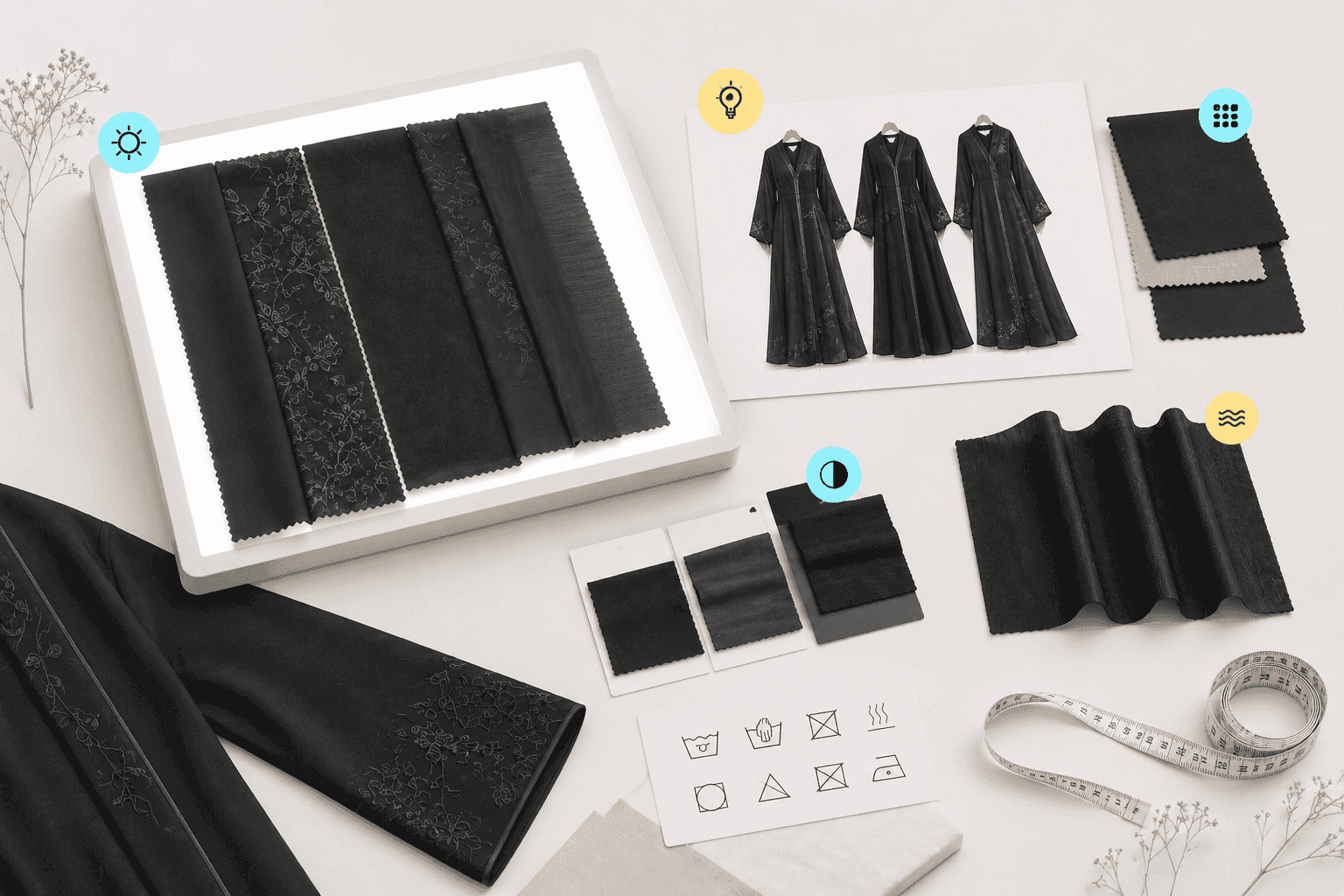
Test the sample in light, movement, and washing before adopting it.
Start with light and transparency, then test drape, wrinkling, and texture. After that, move to the test that is sometimes overlooked: sewing.
Sew a small part in the same way you will execute the abaya. Try the edges, thread type, and needle, and if the design contains embroidery, buttons, or additions, test them on the sample itself. Some problems do not appear until the material goes under the sewing machine.
After that, wash the sample in the way you will recommend to the customer, then compare it with an unwashed sample. Observe color, texture, dimensions, drape, and any surface changes.
If the material succeeds at this stage, move to a full abaya sample. Testing a small square of fabric does not tell you everything about the weight, movement, and fall of the piece when worn.
What should you ask an abaya fabric supplier?
A good supplier is not just the one who gives you a low price, but the one with whom you can build a more stable supply.
When you find a suitable material, ask about the fabric width, the price per meter or the sales unit used, the minimum purchase quantity, the currently available quantities, the resupply lead time, future color availability, the possibility of getting a sample, and whether there are potential differences between batches.
Also ask: is this material available all year round? Is it seasonal? Will this batch be repeated or is it a limited quantity? If I need to reorder in a month or two, how long does it usually take to become available?
This information directly affects the quantity decision. A material you can easily reorder does not necessarily need to be stocked in large quantities, while a basic brand material with a long supply lead time may need different planning.
Also ask about the policy for dealing with defects. What happens if you discover a recurring defect in the fabric after opening the batch? Can the supplier replace it? And when must the problem be reported?
Ready-made template for communicating with the fabric supplier
You can start with a clear message like:
Hello, I am looking for a suitable fabric for [daily / work / travel / occasion] abayas. I need a material in [color], with [light / medium / other] weight, and [description] drape, suitable for [embroidery / daily use / wide cut / other].
I need to know the fabric width, the price per meter or unit of sale, the minimum quantity, whether the material is available all year round or seasonal, future color availability, resupply lead time, and if it is possible to get a sample before buying the quantity.
The more specific your request, the easier it becomes to compare suppliers' offers.
Where do you find wholesale abaya fabric suppliers?
Start from the fabric markets and gatherings in your city, but do not make random visits your only means of searching. Use Google Maps, search engines, and social media platforms to find wholesalers, then prepare a short list before visiting.
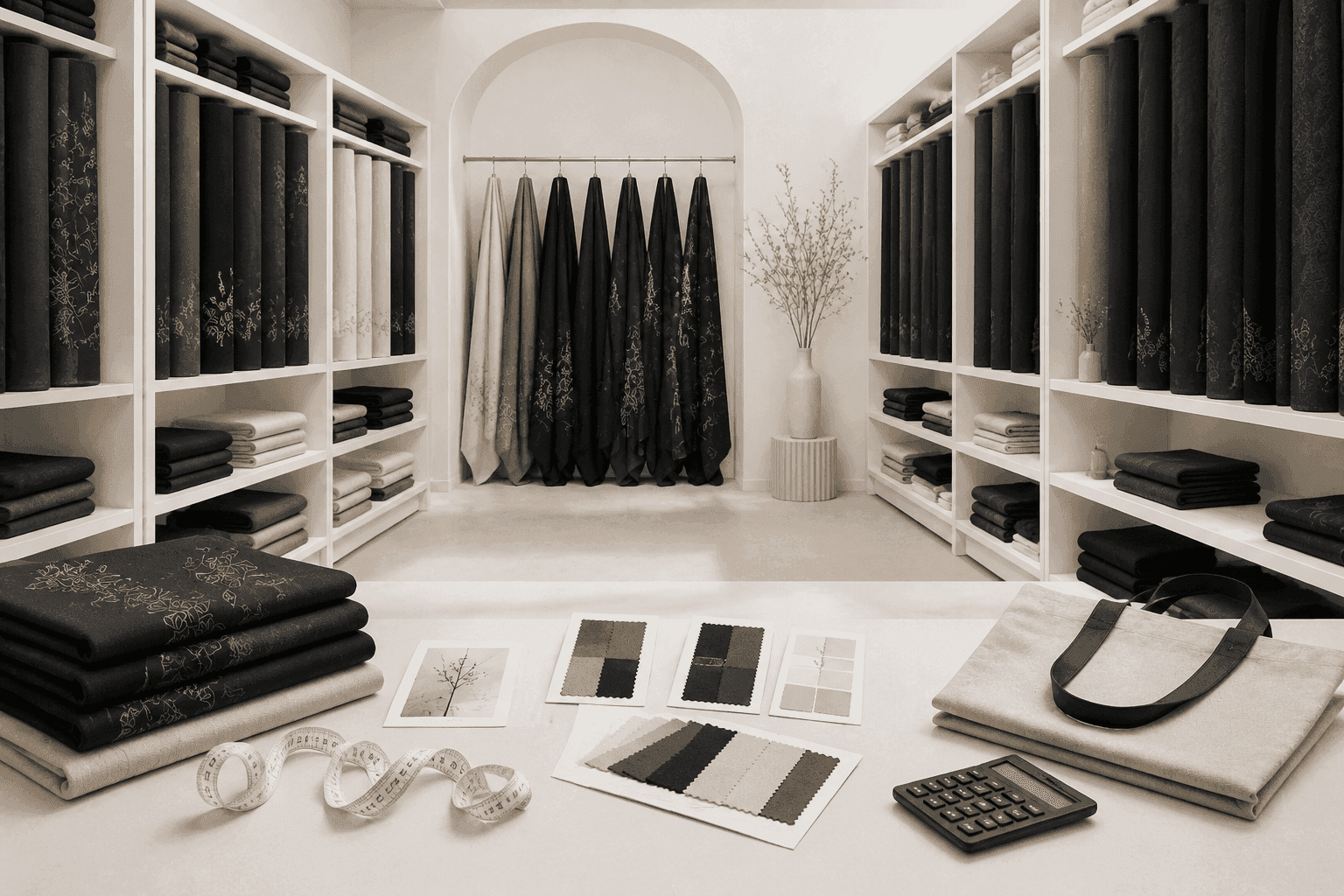
Compare several suppliers and take samples before buying the quantity.
Search with specific terms like "wholesale abaya fabrics + city" or by the name of the material type you are looking for, then contact more than one supplier and ask about specialization, samples, and minimum order quantity before going.
When visiting the market, do not buy from the first shop just because you liked the fabric. Compare the same material or close specifications with more than one supplier. A slight difference in price may not be important if the other supplier provides more consistent quality, faster resupply, and better cooperation when a problem arises.
What should you take with you when visiting fabric suppliers?
Do not go to the market with just a general idea. Take with you the design photo or specification sheet, the color palette or color sample you want to match, and a log where you can write down the details of each material.
Photograph the material code and its information after asking the supplier's permission, and link each photo directly to the supplier's name. After visiting five or six shops, fabrics will look more similar in your memory than you expect.
Most importantly: go with a budget for samples and experimentation, not with the mindset of buying the production quantity on the first visit.
How do you calculate fabric cost in an abaya?
The price per meter alone does not tell you the fabric cost in the product.
Let's assume that the price per meter is 25 Riyals, and the abaya needs 3.5 meters. The initial fabric cost will be:
25 x 3.5 = 87.5 Riyals
But this is not necessarily the final figure. There may be waste in cutting, or the cut may need a larger quantity, or the direction of the pattern or embroidery may dictate a specific way of cutting. Also, fabric width affects the number of meters you need.
Therefore, calculate consumption from the actual sample and pattern, then add a realistic waste percentage based on production.
After that, add sewing, embroidery, accessories, packaging, and any other production costs. In this way, you know the cost of the piece before determining the selling price and profit margin, instead of discovering that the beautiful material ate up the margin after launching the collection.
How much fabric do you buy?
Here all previous decisions come together.
Do not determine the quantity based on the wholesale discount alone. Look at the number of pieces you plan to produce, the consumption of each piece, waste, expected demand, and resupply lead time, then add an important factor: how long do you expect this material to remain sellable?
If it is a basic material you use all year round and you have stable demand for it, buying a larger quantity may make sense after testing it. But if it is linked to summer, winter, or a short season, calculate the quantity based on the actual sales window.
If it is a trend material you have not tested with your customers before, consider launching a limited quantity first. If sales move as you expected and the supplier can resupply quickly, you can increase the quantity instead of freezing the collection budget in unassured stock.
Do not start at full capacity just because the sample succeeded
Even after the success of the abaya sample, there is a difference between the material working technically and the product succeeding commercially.
Start with a limited production quantity when possible, and monitor the product after sale. Do customers mention that the fabric is heavier than they expected? Is the question about transparency repeated? Do you receive remarks about wrinkling or care? And do customers return to buy other pieces of the same material?
This information helps you decide whether it makes sense to buy a larger quantity in the next batch.
Conversely, if the supplier takes a long time to resupply and the material has become basic in your products, you will need to think about safety stock and purchase dates for the next batches before they run out.
Create a brand material library
Over time, you will accumulate dozens of samples. Do not leave them in bags without names.
Create a simple library for approved and unapproved materials. For each material, keep an actual sample and link it to its code, supplier, communication method, supplier's name for the material, color, width, price, minimum order, date, and batch number if any, and the results of transparency, wrinkling, washing, and sewing tests.
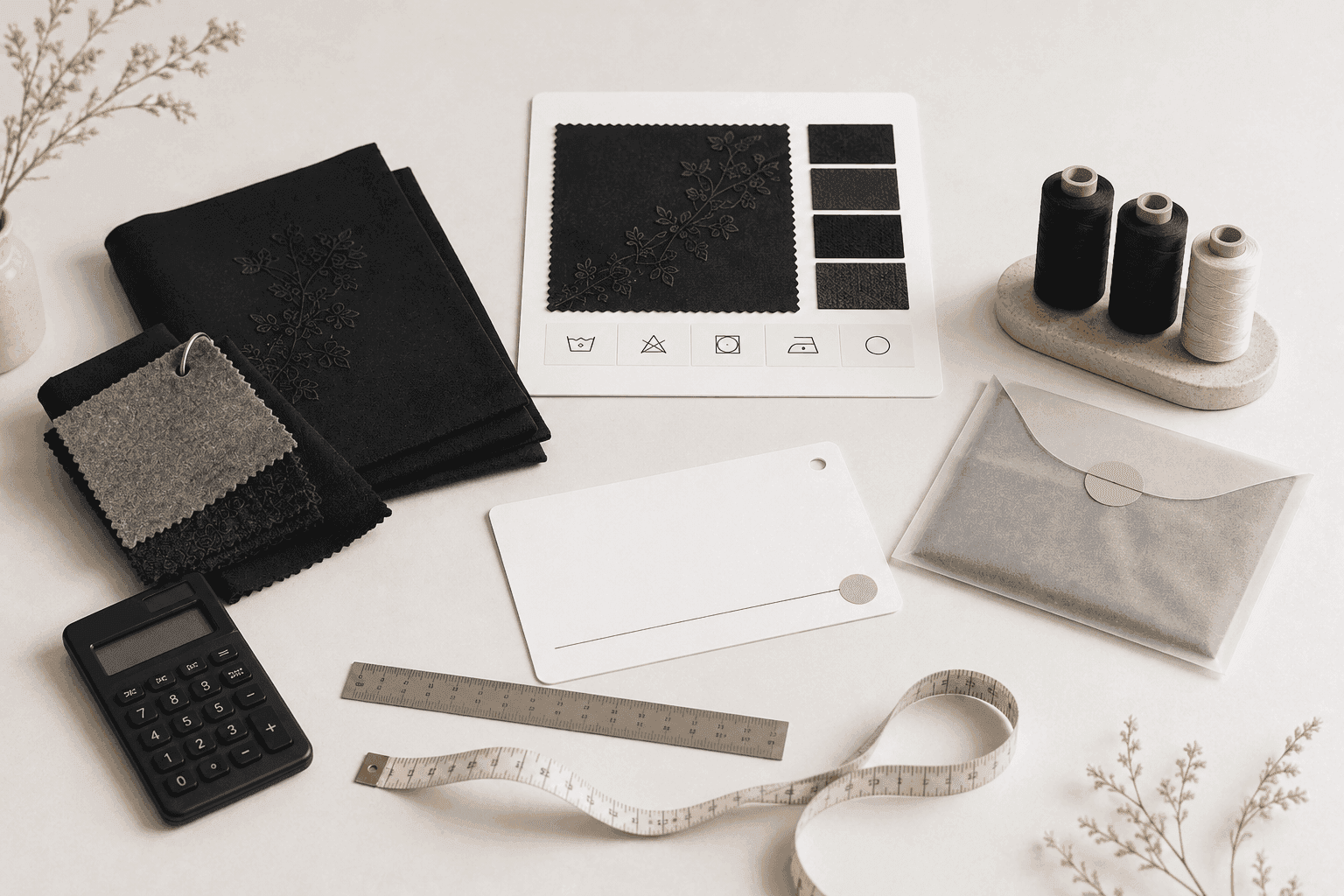
Save fabric code, supplier, batch, and test results.
Seasonality: All year round / Summer / Winter / Specific season.
Nature of demand: Basic / Seasonal / Trend.
Continuity of supply: Continuous / Seasonal / Limited batch.
Also record any design that used this material and how the product performed after sale.
After several collections, this library will become a real asset for the brand. Instead of starting the search from scratch with each design, you will know that a certain material succeeded for work, another gave a good result with wide cuts, a third did not succeed in washing, and a fourth is beautiful but linked to a short season and is not worth storing a large quantity of.
When you adopt the material, let the customer know what they are buying
After the fabric moves from sample to product, the information you gathered turns into part of the product page.
Do not just write a commercial name for the material that might mean nothing to the customer. Clarify what helps them make a decision: Is the fabric light or medium? How does its drape look? Does it need specific care? Does it suit a specific season or weather?
Here, photos become very important. A full photo showing how the abaya falls, a closer shot showing the fabric texture or embroidery, and clear information about sizes and care reduce the gap between what the customer imagines and what they receive.
Salla provides, among product management tools, the ability to add photos, options, and product information, helping the abaya store present clearer details to the customer before purchasing.
Checklist before buying abaya fabrics wholesale
Did you determine the abaya's use and cut before searching for the material?
Is the material permanent all year round, seasonal, or linked to a trend?
Did you ask the supplier if the material is continuous or a limited batch?
Did you link the purchase quantity to the season duration and resupply possibility?
Did you test weight, drape, transparency, and wrinkling?
Did you try sewing and details on a sample of the fabric?
Did you wash the sample in the suggested care method?
Did you make a full abaya sample before production?
Did you record the material code, supplier, width, color, and batch?
Did you compare more than one supplier instead of relying on price alone?
Do you know the minimum quantity and resupply lead time?
Did you calculate the actual consumption, waste, and fabric cost for each abaya?
Will you start with a limited production quantity before committing to a large amount?
Frequently Asked Questions about Abaya Fabrics
What is the best fabric for daily abayas?
There is no single fabric that is best for all abayas. Look for a fabric that suits the cut, climate, and way of use, and achieves the balance you want between comfort, transparency, drape, wrinkling, and care. The most important thing is to actually test the material before adopting it.
What is the best fabric for summer abayas?
Start with materials that achieve the comfort and lightness suitable for the weather you are targeting, but do not make lightness the only criterion; test transparency, drape, durability, and care as well. The cut itself may need a different material even if the product is within the summer collection.
What is the best fabric for winter abayas?
Look for the weight, texture, and drape suitable for the design and the weather the product will be used in. Heavier fabric is not automatically better; it should not make the abaya tiresome or change the cut you want.
Should I buy fabric by the meter or in wholesale quantities?
When trying a new material, start with a sample or a quantity sufficient to make the initial prototype whenever the supplier allows. Move to a larger quantity after knowing the abaya's consumption, testing the material and sample, and ensuring it is suitable for production.
How do I know if a trend material is worth buying a large quantity?
Do not rely on its popularity alone. Look at its suitability for your customers, the speed of trend change, supply lead time, and the possibility of reordering. If demand is untested and the trend is fast, limited production first may be less risky.
How can I make sure that the fabric color will not differ in the next order?
You cannot always assume batch matching. Keep an actual sample, fabric code, and batch information, and ask the supplier about supply stability. When a new batch arrives, compare it with the previous sample before using it with old stock.
How do I know how much fabric the abaya needs?
The quantity depends on the design, length, size, fabric width, cut, pattern placement, and details. Therefore, do not adopt a general number for all abayas; calculate consumption from the pattern and the actual sample before buying the production quantity.
Continue building your abaya collection
After adopting the fabric, you move to the decision of how you will produce the abaya: individual tailoring, workshop, private production, or buying ready-made wholesale? Then comes sampling, pricing, preparing sizes, photographing the product, and building the store page.
Every decision here affects the next, so keep fabric data, cost, supplier, seasonality, and supply continuity from the beginning. In this way, choosing fabric is not just a step in making the abaya, but part of managing the collection, inventory, and profitability.
Sources and Resources
Salla — Solutions for Abaya Stores
How to Build a Growing Abaya Store? 5 Lessons from the (Al-Alia) Abayas Experience
6 minutes read

Wholesale abayas for businesses and retailers: A guide to building a B2B sales channel
10 minutes read
From Selling on Instagram and WhatsApp to an Abaya Store: A Transition Plan Without Losing Your Customers
10 minutes read
Mohammed Al-Anazi
Product Manager at Salla
49
Article
Featured author

E-commerce
How to Build a Growing Abaya Store? 5 Lessons from the (Al-Alia) Abayas Experience
Al-Alya’s experience shows that growing a fashion store is not just about attracting more traffic. Sustainable growth comes from improving the entire customer journey: reducing hesitation, recovering abandoned carts, offering relevant promotions, simplifying payment, and continuously optimizing the shopping experience.
6 minutes read
Arwa Abdulkarim

Fashion
Wholesale abayas for businesses and retailers: A guide to building a B2B sales channel
Start selling abayas wholesale with a clear offer built for a specific customer segment, including your catalog, order quantities, pricing, samples, and delivery terms. Test demand with a focused approach before expanding your wholesale channel.
10 minutes read
Mohammed Al-Anazi

Fashion
From Selling on Instagram and WhatsApp to an Abaya Store: A Transition Plan Without Losing Your Customers
Maintain your accounts and relationship with female customers, and gradually transition abaya selection, payment, and shipping address to the store. Start with clear products and test demand before expanding the launch.
10 minutes read
Mohammed Al-Anazi
Fashion
How to move your abaya shop online and manage inventory for both channels together?
Start by auditing every model, size, and color, and unifying the codes; then test the integration of the cashier and the store, as well as the cancellation and exchange procedures. Expand after stabilizing inventory and fulfillment.
11 minutes read
Mohammed Al-Anazi