11 min read

Mohammed Al-Anazi
Product Manager at Salla
Would you like to read a summary of the article?
Summarize with ChatGPT
Summarize it with Claude
Summarize it with Perplexity

An abaya business idea may start from a design, a fabric type, or a different style you want to present. But at some point, you will stand before a field that seems simple yet consumes more time than you expected: What do I name the brand?
The problem is that the name will appear in many places later: on the storefront, the Instagram account, the packaging, the abaya tag, the order confirmation message, and perhaps on a branch or exhibition in the future. Therefore, it is not enough for it to look nice in a list of names on a mobile phone; it must be able to live with the business as it grows.
The good news is that you don't need to wait for a "moment of inspiration." You can treat choosing a name as a decision that can be built and tested step-by-step.
10 Abaya Brand Names to Start Brainstorming
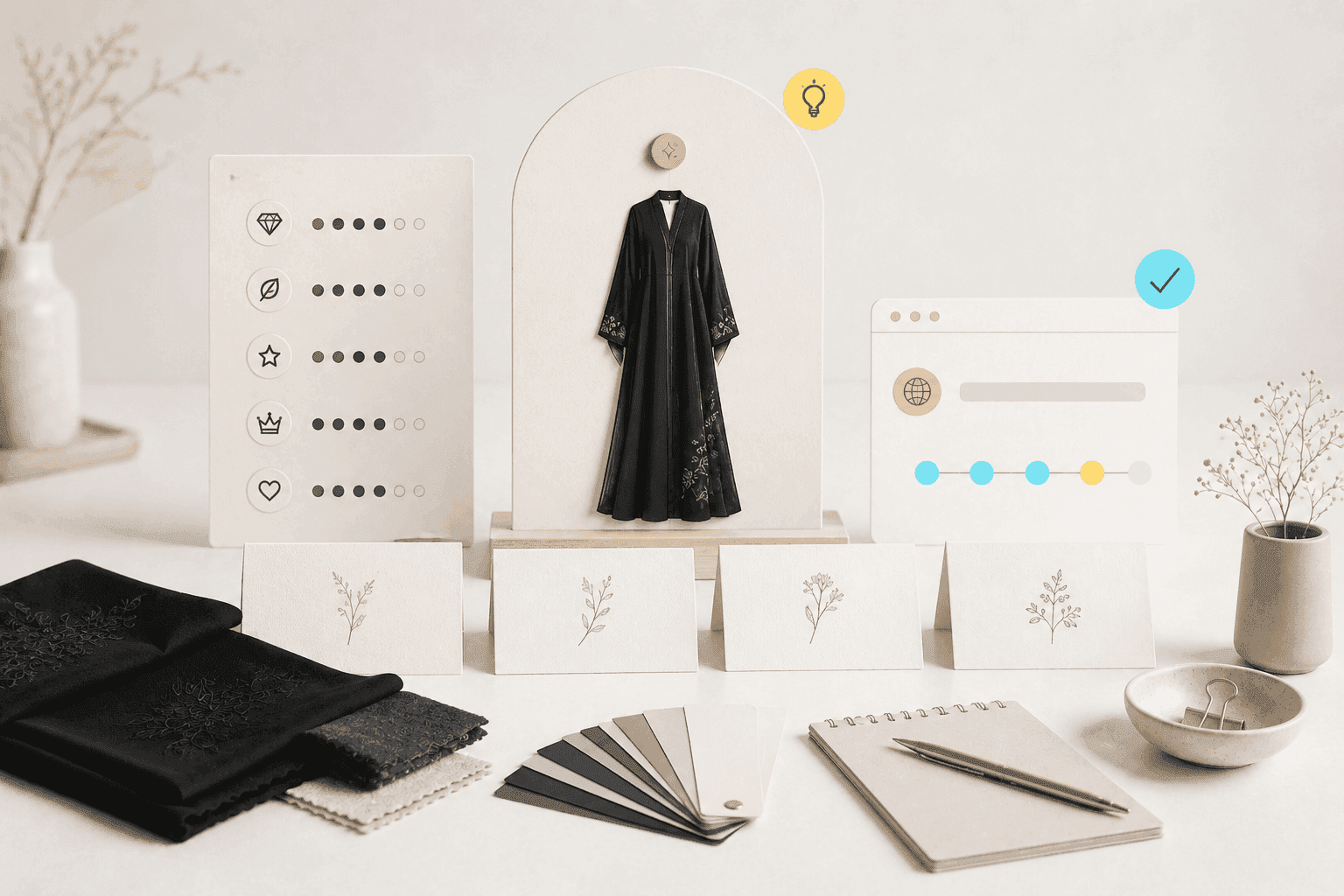
Start with the direction and meaning of the name before building the identity.
If you don't know where to start, here are ten directions that can help you open up the circle of ideas. Remember that the goal is not to choose one of them directly, but to notice what kind of meaning the brand name can carry.
Samat: Suggests demeanor and style; it may suit a brand with a calm and distinct presence.
Rawaa: Carries the meaning of beauty and splendor, and can suit a brand that cares about details and elegance.
Sakan: Gives a sense of tranquility and comfort, and may suit daily and practical abayas.
Nasj: Linked to fabric and craft, so it could be a suitable direction for a brand focusing on materials or design.
Thil: Short and simple, and a clear visual identity can be built around it.
Mada: Carries the meaning of vastness and continuity, and does not limit the brand to a specific type of abaya.
Leen: Suggests lightness, comfort, and softness.
Athar: Suits a brand that wants to build a clear story or meaning around its products.
Sadal: Close to the movement and draping of fabric, and relates to the nature of the product without directly using the word "abaya."
Mihad: Suggests comfort and stability, and can head towards a calm and simple identity.
Important: These names are ideas for brainstorming only. The presence of a name here does not mean it is available for use or registration, nor that it is not used by another brand. Check the name legally, commercially, and digitally before adopting it.
Before you search for a name, define what you want it to say about the brand
It is easy to gather dozens of beautiful words, but the most important question is: What do you want the customer to feel when they hear the name?
If you are building a brand for office and daily abayas, you might look for a simple, light name close to a lifestyle. If the idea is based on cuts, embroidery, and craft, a name linked to fabric or details might be more appropriate. But if you want to build a brand that can expand later to sheilas (headscarves) or other modest fashion items, steer clear of a name that limits you to a single design or product.
Start with four corners: the style of the abayas, the feeling you want to give the customer, the primary use, and the story of the brand. Write down several words under each corner. Under style, you might find words like calm, loose, simple, embroidered; under feeling, words like comfort, confidence, presence, lightness; under primary use, daily, work, travel, occasions; while the brand story might lead you to a place, a memory, a craft, or a word with a special meaning.
You do not need to use these words as they are. Their purpose is to give you a linguistic world from which to extract the name, instead of a random search for "luxurious names for an abaya business."
Does the name need the word "abayas"?
Not necessarily. A name like "Name for Abayas" clarifies the activity directly, and this can be useful in some cases. However, it binds the brand to a single category from the beginning. A standalone name may initially need a definition like "Samat | Abayas," but it gives you more space if the brand expands in the future.
Imagine, for example, that you started with work abayas, then after two years you added sheilas, modest pieces, or accessories. Will the name still make sense?
That's why you shouldn't test the name only with the first product you will sell. Test it with the brand you want to become.
How do you evaluate abaya business names instead of choosing by personal taste?
After brainstorming, do not try to choose between twenty names. Select the best five, then evaluate them against five simple criteria.
Ease of pronunciation: Can a person pronounce the name the first time, or does it need correction and explanation?
Ease of writing: If a customer hears it in a video or from someone else, can they search for it easily, or are there several potential ways to write it?
Distinctiveness: Does it look independent, or does it resemble dozens of names existing in the abaya and fashion sector?
Appropriateness: Does it suit the type of abayas, the brand persona, the price level, and the audience you want to reach?
Scalability: Can the name live with new collections and categories, or will it look strange as soon as you step outside the product you started with?
Give each name a score from 1 to 5 for each criterion. You won't necessarily get a perfect name, but the comparison will quickly reveal the difference between a name you personally liked and a name that can actually work as a brand.
Test the name as it will appear to the customer
Before designing the logo, take the best three names and place them in the locations where the name will actually live.
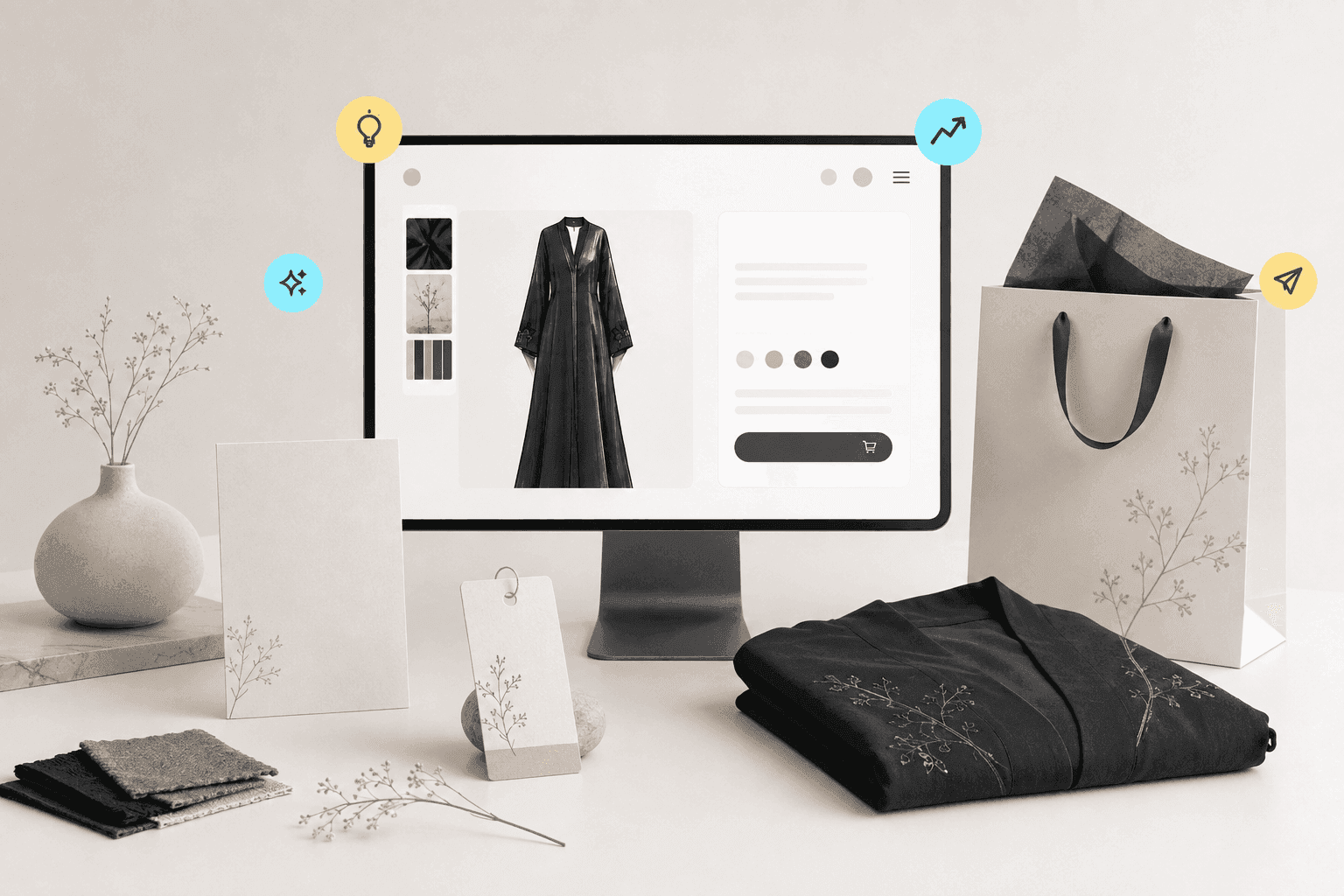
Test the name as it will appear on the store, the packaging, and the product page.
Write for example: Samat | New Work Abayas. Then try the name on an abaya tag, at the top of a store page, in a social account name, and in a message like: "Your order from Samat has been received."
Read it aloud. Then say the name to someone without them seeing it and ask them to write it down. If you need to spell it out every time, this is a signal worth paying attention to, especially if you expect customers to hear the brand name in videos or word-of-mouth recommendations.
Try it also with more than one collection: daily abayas, occasion abayas, and perhaps another category you are thinking of adding in the future. In this way, you test the name as a brand, not just as a title for the first collection.
Do not adopt the name before searching for similar names
The success of the name in the linguistic and visual test does not mean it is ready for use.
Search for the name itself and close spellings in both Arabic and English, then search for it with words like "abayas," "fashion," and "store." Do not look only for exact matches; also pay attention to names close in pronunciation or shape, which might make customers confuse the two brands.
In Saudi Arabia, the Saudi Authority for Intellectual Property provides a service to search the registered trademark database, which can be used as part of the initial verification steps before proceeding with trademark registration.
After that, check the commercial name procedures with the competent authority, and check the domain you want to use and the important social communication accounts for your business.
This stage must come before paying for the logo, packaging, and photography design. Changing a name in a notes list is easy; changing a name printed on a thousand boxes is not.
What if the name is available but the Instagram handle is not?
Do not make the availability of a 100% matching username the factor that decides the entire future of the brand.
If the name is suitable for the brand and passes legal checks, you can study a clear formula for the account or domain that adds a word related to the brand without distorting the name. The important thing is that the formula does not become long, confusing, or close to another brand's account.
Here again, the importance of ease of writing and searching becomes clear. You are not just choosing a beautiful word; you are choosing something the customer will try to find after seeing or hearing it.
If you plan to expand into the Gulf, test the name outside your market too
A name may be clear in Saudi Arabia but carry a different meaning or sound strange in another market. If your plan includes selling to Gulf countries or an English-speaking audience, test how it is pronounced and written in English before adopting it.
It is not required for the name to be global from day one, but it is useful to discover obvious problems now instead of discovering them after building the brand.
This flexibility is especially important if expansion is part of your vision; Salla provides solutions for the abaya sector that help merchants build their store, manage the selling experience, and expand.
Checklist before adopting an abaya business name
Before you say "this is the name," make sure you can answer yes to most of these questions:
Is the name easy to pronounce, remember, and write?
Does it suit the brand persona and the products you want to sell?
Can it live with the business if it expands?
Have you searched for its spellings and similar names?
Have you checked registered trademarks and the commercial name with the competent authorities?
Have you checked the domain and digital accounts you need?
Have you tested how it appears in Arabic and English if you will use both formats?
Have you tried it on a store, product page, packaging, and order message?
If the name passes this stage, you have a stronger foundation to move to identity and the store, instead of building the entire business around a name you chose in a moment of admiration.
The name is the first decision in the brand, not the whole brand
You may spend days looking for the perfect name, but the customer will not return to your store because the name is beautiful alone. What will give the name its meaning over time is the product, design, quality, photography, packaging, service, and the experience you associate with it.
So look for a name good enough to carry the brand and grow with it, check it well, and then move on to the decisions that will make people remember it.
After adopting the name, you can move on to building the brand identity and setting up the abaya store. Salla dedicates solutions for the abaya and fashion sector that help build the store, display products, and manage the sales journey.
Frequently Asked Questions about Abaya Business Names
Must the business name contain the word "abayas"?
No. Having the word "abayas" may make the activity clear quickly, but a standalone name may give the brand greater flexibility if it adds other categories in the future. The decision depends on how important immediate clarity is versus scalability.
Is an Arabic name better or an English one?
There is no rule that makes one always better. Choose the name that suits your audience and brand persona, and is easy to pronounce, write, and search for. If you will use the name in Arabic and English, test both formats before adopting it.
How do I make sure the abaya business name is not used?
Start by searching for the name and close names on the internet and social media platforms, then check trademarks and the commercial name through official entities in your market. In Saudi Arabia, the Saudi Authority for Intellectual Property allows searching registered trademarks.
Should I buy the domain before registering the trademark?
It is best to look at verifying the name, trademark, domain, and digital accounts as a single process before investing in the identity. The availability of the domain alone does not mean the name is legally available for use as a trademark.
What do I do if I like a name but it is hard to write?
Test the size of the problem first. If most people write it differently after hearing it, you may pay the price for that later in search, word of mouth, and reaching your accounts. A beautiful name that is hard to find may not be the best commercial choice.
Continue building the abaya business
After the name come bigger decisions: How do you build an abaya brand from scratch? How do you choose the products and the first collection? And how do you
prepare an abaya store to receive its first order? It is best to look at these decisions as a single journey, so that the name supports the product, identity, and the experience you want to build, instead of each part working separately from the other.
Sources and Resources
Saudi Authority for Intellectual Property — Search Registered Trademarks
How to Build a Growing Abaya Store? 5 Lessons from the (Al-Alia) Abayas Experience
6 minutes read

Wholesale abayas for businesses and retailers: A guide to building a B2B sales channel
10 minutes read
From Selling on Instagram and WhatsApp to an Abaya Store: A Transition Plan Without Losing Your Customers
10 minutes read
Mohammed Al-Anazi
Product Manager at Salla
49
Article
Featured author

E-commerce
How to Build a Growing Abaya Store? 5 Lessons from the (Al-Alia) Abayas Experience
Al-Alya’s experience shows that growing a fashion store is not just about attracting more traffic. Sustainable growth comes from improving the entire customer journey: reducing hesitation, recovering abandoned carts, offering relevant promotions, simplifying payment, and continuously optimizing the shopping experience.
6 minutes read
Arwa Abdulkarim

Fashion
Wholesale abayas for businesses and retailers: A guide to building a B2B sales channel
Start selling abayas wholesale with a clear offer built for a specific customer segment, including your catalog, order quantities, pricing, samples, and delivery terms. Test demand with a focused approach before expanding your wholesale channel.
10 minutes read
Mohammed Al-Anazi

Fashion
From Selling on Instagram and WhatsApp to an Abaya Store: A Transition Plan Without Losing Your Customers
Maintain your accounts and relationship with female customers, and gradually transition abaya selection, payment, and shipping address to the store. Start with clear products and test demand before expanding the launch.
10 minutes read
Mohammed Al-Anazi
Fashion
How to move your abaya shop online and manage inventory for both channels together?
Start by auditing every model, size, and color, and unifying the codes; then test the integration of the cashier and the store, as well as the cancellation and exchange procedures. Expand after stabilizing inventory and fulfillment.
11 minutes read
Mohammed Al-Anazi