


تم النشر 1 week ago
10 min read

Arwa Abdulkarim
Product Marketing Manager
Would you like to read a summary of the article?
Summarize with ChatGPT
Summarize it with Claude
Summarize it with Perplexity

At the abaya shop, the customer can see the color under the light, touch the fabric, notice the cut, try the length and size, move around in the abaya in front of the mirror, and then ask about any detail that remains unclear.
In the online store, most of these things have disappeared. However, the customer is still required to make the exact same decision:
Is this abaya right for me?
Here, the product page becomes more than just a place where we upload photos and set prices and sizes. It is the one that must compensate as much as possible for what the customer lost when she moved from the shop to the screen; from seeing details and understanding the fabric and cut, to choosing the size and length and knowing what will happen if the product does not fit her after receipt.
Because of this, when you add an abaya to your store, do not just ask: Did I enter the product details? Ask: Have I given the customer enough information to choose with confidence without the abaya being in front of her?
The less her ability to try the product herself, the more responsible the product page is for helping her choose.
Start with the question on the customer's mind: How will it look on me?
You may have ten beautiful photos of the abaya, yet the customer is still unable to make her decision. Because the quality of product photos is measured not only by their number, but by the information each photo adds.
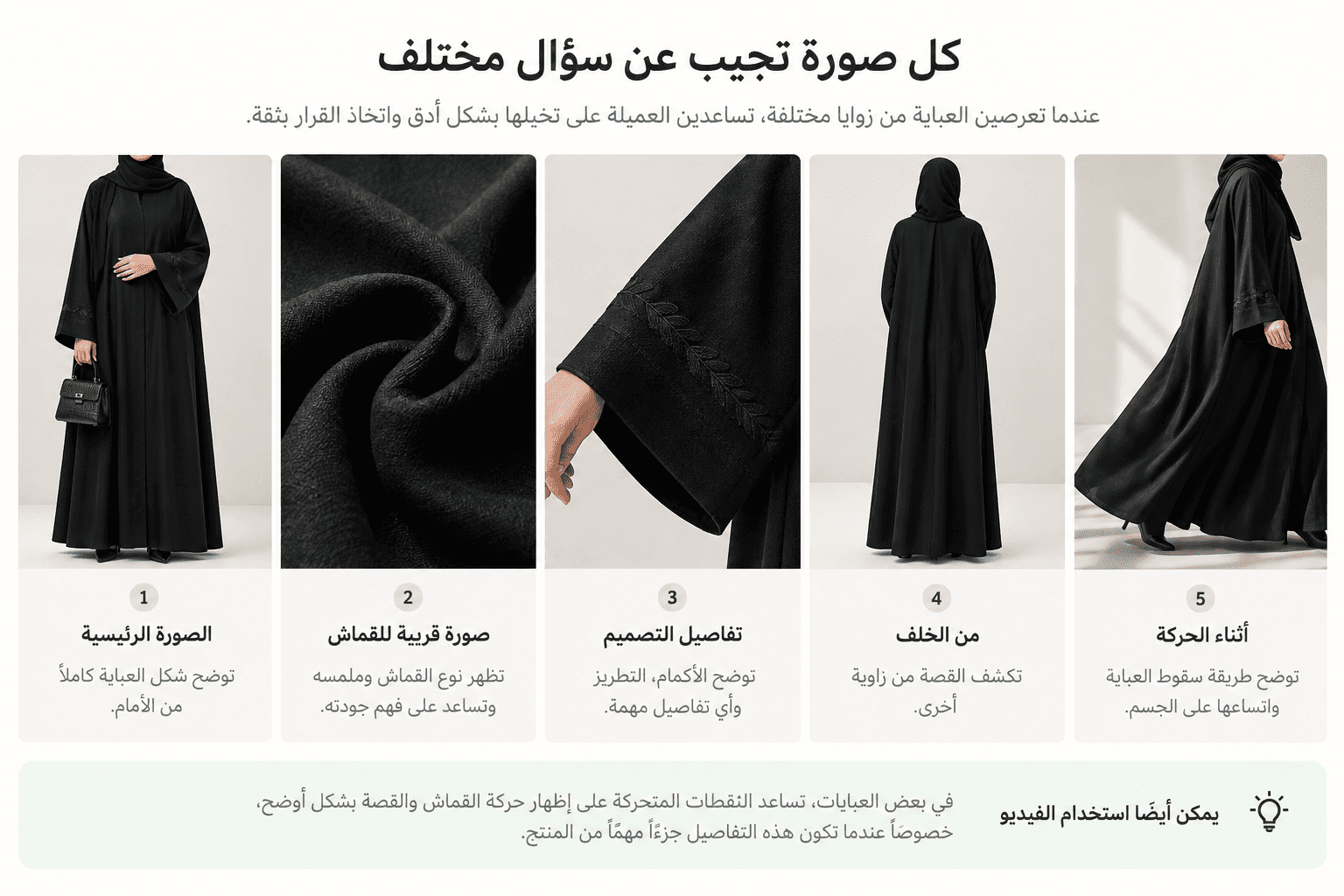
The main photo helps her see the entire abaya, a closer photo shows the fabric, embroidery, or sleeve details, a photo from behind the abaya reveals the cut from another angle, and a photo while wearing it helps understand the length, width, and how the abaya falls on the body.
Before uploading photos, try a simple question: What will the customer know from this photo that she did not know from the previous photo?
If five photos answer the same question, you probably do not need a similar sixth photo. But if the photos are beautiful but do not explain a detail that could affect the purchase decision, there is a missing visual information no matter how professional the photography is.
For some abayas, there remain things that are difficult for a static image to convey. This is where video becomes useful, especially when the movement of the fabric, the width of the cut, and the way the sleeves or details appear during movement are an important part of the product.
The goal is not only to make the product page look prettier, but to make the distance between what the customer imagines and what will actually reach her as short as possible.
Write what the customer would have asked about in the shop
Imagine that the customer pointed to an abaya in front of her and asked: What type of fabric is it? Is it heavy or light? Is the cut wide? Does it come with a veil? Is the embroidery like this all over the abaya? And is the color in reality like the photo?
These questions do not disappear when you move to sell online. What disappears is only the person next to the customer to answer them.
Therefore, a description like (an elegant abaya with a luxurious design suitable for all your occasions) may sound beautiful, but it does not help much in making a choice.
A better description tells the customer what she actually needs to know: the nature of the fabric, the cut, important details, accompanying pieces, and any information that might make the product different from what the photos alone suggest. Even the product name has a role; a clear name helps the customer distinguish between models and return to the product she liked, instead of all the abayas' names turning into a collection of beautiful phrases that are difficult to differentiate between.
There is a useful test here:
If there was no one the customer could message, does the product page contain the information she needs to decide?
Every recurring question you receive about the abaya may actually be a suggestion to improve its page.
Prompt for writing the abaya description
I will give you information about an abaya I sell in my online store. Write a clear product description that helps the customer make a purchase decision, not an exaggerated marketing description. Explain the fabric, the cut, details, colors, accompanying pieces, and any information that affects the choice. Do not add any information I did not mention, and if there is important missing information, ask me about it before writing the description.Abaya data: [Add product data here]
Size is not just a number on a list
This is probably the most sensitive point when buying an abaya online.
The presence of options like 52, 54, and 56 does not necessarily mean that the customer now knows which one fits her. She needs to understand what the size means in this specific model.
This point also appeared in our conversations with abaya merchants; the size may not work the same way in every design, and the need for a size chart may differ depending on the cut and model.
If one abaya is wide and the other is straight, or there is an important difference in length or width, a general chart for all store products may not be enough. The important thing is that the information affecting the size choice is linked to the product the customer is looking at.
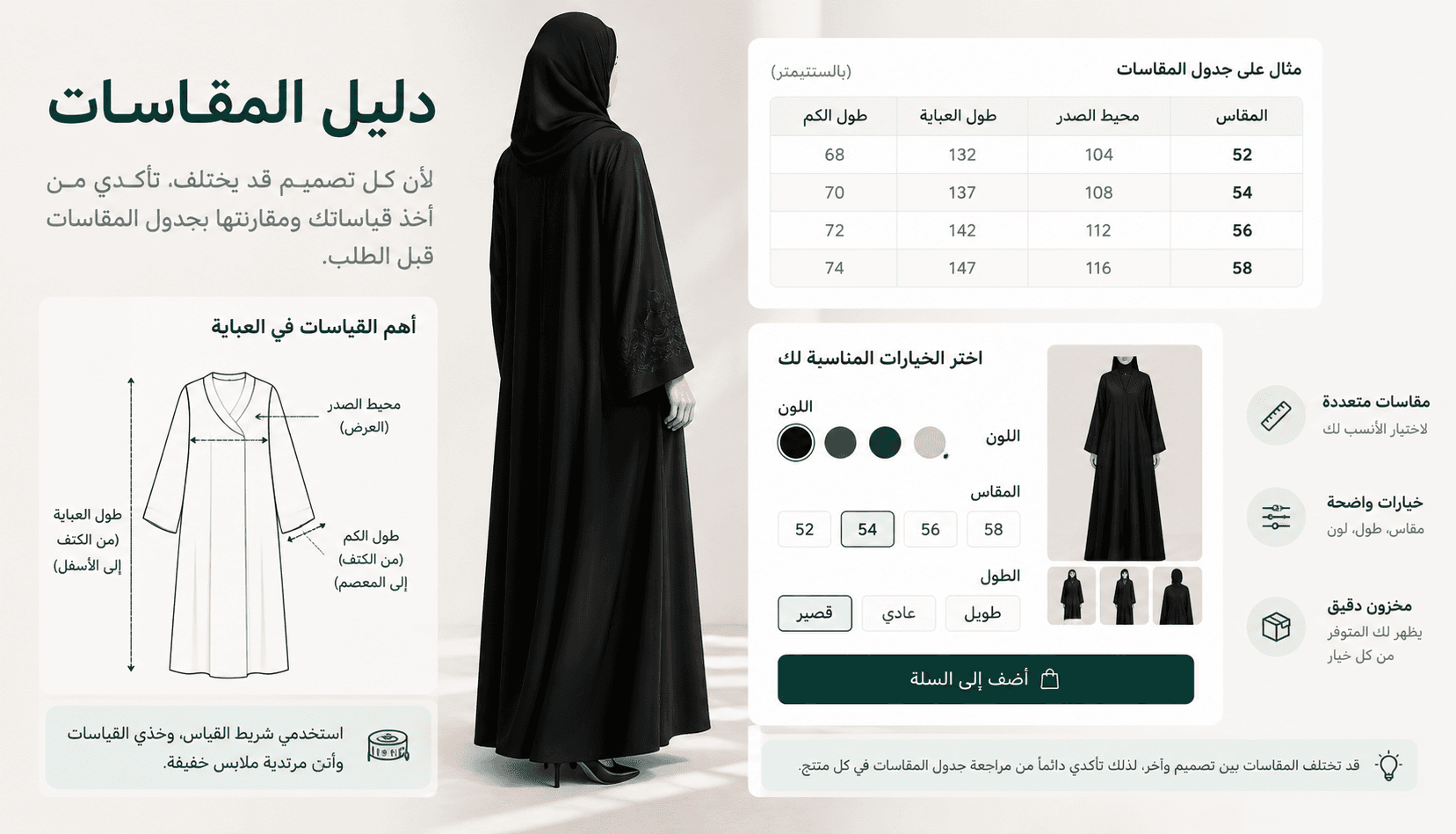
Clarify important measurements, available lengths, how to measure when you need to explain, and any variation in the cut that might make the customer choose differently than usual.
A size chart does not do its job when it only displays numbers; it does its job when it helps the customer convert her measurements into a choice.
Prompt to clarify sizes to the customer
These are the measurements of an abaya in my store: [Add measurements]. And this is the cut and length information: [Add information]. Help me convert them into a simple and clear size guide for the customer, and explain how to choose the right size. Do not assume any measurements or characteristics not present in the data I gave you.
Options should make choosing easier, not add new confusion
A single abaya may have more than one length, size, or color, and perhaps other options depending on the product. Every option you add to the product page must be clear to the customer and linked to what is actually available.
If she chooses a specific length and size, she should not reach the end of the journey to discover that this option is not available. And if the product photo changes depending on the color, it is better that the photos help her know what she is choosing instead of relying on the color name alone.
Here, managing quantities and inventory becomes part of the product experience itself, not just back-end work inside the store. Because an error in inventory may start as a small internal setting, but it reaches the customer in the form of an order that cannot be fulfilled.
The more options the abaya has, the more important it is that the method of choice is simpler than the number of options themselves.
Do not make the customer discover order details after she decides to buy
The abaya page may be excellent, the size clear, and the photos convincing, then the customer reaches the next step and new questions appear: How will I pay? When will it arrive? How much is shipping? And what if the size doesn't fit me?
These are not details completely separate from the product, because they enter into her purchase decision.
This does not mean that you put all the store settings inside the abaya page, but important information must be easy to access and clear at the right time, and payment, shipping options, and the checkout experience must be prepared before you start bringing customers to the products.
The goal is for the customer to move from «this abaya fits me» to «I can buy it now» with the fewest possible new questions.
Apply it to an abaya product step by step
After publishing, the product page starts teaching you
Adding a product does not end with clicking "Publish." When customers start viewing and buying the abaya, you start getting one of the best sources of page optimization: their questions and what happens after the purchase.
If the question "Is the fabric see-through?" is repeated, perhaps the description was not enough. If most messages ask about the length, the way sizes are displayed needs to be reviewed. And if exchanges are concentrated in one model or a specific size, this is a signal that is worth returning to the product page for, rather than dealing with each case as a separate exchange request.
Here, our view of questions, exchanges, and returns changes. Instead of being problems that happen only after the sale, they become data telling us what the product page could not explain before the sale.
Not every return is caused by the product page, of course, nor can every customer be prevented from changing her mind. But when the same reason is repeated, there is something worth investigating.
A return sometimes begins before the purchase, in information that was not clear when the customer made her decision.
And even with the best product page… make the exchange and return policy clear
No matter how accurate the photos are, how clear the sizes, and how detailed the description, you will not be able to guarantee that every abaya will fit every customer the first time. This is normal.
Therefore, the exchange and return policy should not be treated as a page we place a link to at the bottom of the store and finish with. For a product that the customer cannot try on before buying, knowing what will happen if the product does not fit her is part of the confidence she needs to make the decision in the first place.
Clarify which products can be exchanged or returned, the time allowed for that, the condition the product must be in, how the customer starts the request, and what relates to shipping costs according to your store policy. If you have products with special tailoring or modification subject to different conditions, the customer must know that before ordering, not after they arrive.
Clarity here serves both parties: the customer knows what she is agreeing to, and the store reduces the room for dispute and poor expectations after purchase.
A good product page helps the customer choose the abaya with confidence, and a clear exchange and return policy tells her what will happen when the choice is not suitable despite that.
Before you publish the abaya, give its page to someone who hasn't seen it before
Do not explain the product to them, nor tell them what you mean by the photos or options. Just give them the page as the customer will see it, then ask them:
Did they know the shape and details of the abaya? Did they understand the nature of the fabric and the cut? Can they choose the right size and length? Are the options clear? Do they know what will arrive with the order? And do they know what to do if the abaya arrives and does not fit them?
Every "no" answer does not mean the product is not ready for sale; it means there is information you know about the abaya that has not yet reached the customer.
Prompt to review the abaya product page before publishing it
I will share with you the content of an abaya product page. Review it as if you were a customer seeing it for the first time and cannot try the abaya or ask the seller. Identify the information that helps in making a choice, and what is still missing or unclear in the photos, fabric, cut, size, length, options, what comes with the product, shipping, and exchange and return. Do not rewrite the page directly; first give me a list of the shortcomings and questions that the customer might still have.Product page: [Paste content here]
This is the difference between adding a product to the store and actually preparing it for sale online.
How to Build a Growing Abaya Store? 5 Lessons from the (Al-Alia) Abayas Experience
6 minutes read

Wholesale abayas for businesses and retailers: A guide to building a B2B sales channel
10 minutes read
From Selling on Instagram and WhatsApp to an Abaya Store: A Transition Plan Without Losing Your Customers
10 minutes read
Arwa Abdulkarim
Product Marketing Manager
11
Article
Featured author

E-commerce
How to Build a Growing Abaya Store? 5 Lessons from the (Al-Alia) Abayas Experience
Al-Alya’s experience shows that growing a fashion store is not just about attracting more traffic. Sustainable growth comes from improving the entire customer journey: reducing hesitation, recovering abandoned carts, offering relevant promotions, simplifying payment, and continuously optimizing the shopping experience.
6 minutes read
Arwa Abdulkarim

Fashion
Wholesale abayas for businesses and retailers: A guide to building a B2B sales channel
Start selling abayas wholesale with a clear offer built for a specific customer segment, including your catalog, order quantities, pricing, samples, and delivery terms. Test demand with a focused approach before expanding your wholesale channel.
10 minutes read
Mohammed Al-Anazi

Fashion
From Selling on Instagram and WhatsApp to an Abaya Store: A Transition Plan Without Losing Your Customers
Maintain your accounts and relationship with female customers, and gradually transition abaya selection, payment, and shipping address to the store. Start with clear products and test demand before expanding the launch.
10 minutes read
Mohammed Al-Anazi
Fashion
How to move your abaya shop online and manage inventory for both channels together?
Start by auditing every model, size, and color, and unifying the codes; then test the integration of the cashier and the store, as well as the cancellation and exchange procedures. Expand after stabilizing inventory and fulfillment.
11 minutes read
Mohammed Al-Anazi