12 min read

Mohammed Al-Anazi
Product Manager at Salla
Would you like to read a summary of the article?
Summarize with ChatGPT
Summarize it with Claude
Summarize it with Perplexity

An abaya idea might start with a simple sentence: a practical, loose-cut abaya for work, a lightweight, wrinkle-free travel abaya, or an occasion piece with unique sleeve detailing. The problem is that turning this mental image into something another person can see and understand is not always easy.
This is where artificial intelligence can shorten a significant part of the journey. Instead of searching through dozens of pictures and trying to explain "I want something close to this, but with sleeves like that, and a calmer color," you can describe the idea and experiment with multiple visual directions until you get close to the shape you want.
However, there is an important difference between visualizing an abaya and designing it for production. An AI-generated image can help you see the cut, color, sleeves, and embroidery, but it does not automatically tell the tailor the chest width, sleeve opening, or fabric consumption, nor does it guarantee that the cut will drape and move well when worn.
Therefore, use AI as a quick space for experimentation and decision-making, then translate your chosen direction into specifications and an actual physical sample before production.
Do not start with the prompt, start with the abaya you want to sell
It is easy to open an AI tool and write "design a luxurious black abaya for me," and you will likely get a beautiful image. But is it suitable for work? Can its sleeves be realistically made? Do its details match your target price? And does the customer even need it?
Before writing any Prompt, define who this abaya is for and when it will be worn.
For example, a work abaya might require comfortable movement, practical fabric, useful pockets, and details that do not hinder daily use. A travel abaya has different considerations, and an occasion abaya can accommodate a grander presence in fabric, cut, or embroidery.
Write down four points for yourself before starting: the use, the target customer, the impression you want the abaya to give, and the limits you do not want to exceed in design or cost.
In this way, artificial intelligence becomes a tool for developing a specific product, rather than just a generator of beautiful abaya pictures.
What can AI actually do for you?
Its primary value at this stage is the speed of visualization and comparison. You can test the same cut in different colors, see the effect of changing the sleeves, compare light embroidery with a more prominent detail, or test an entire collection's direction before purchasing fabrics and making samples.
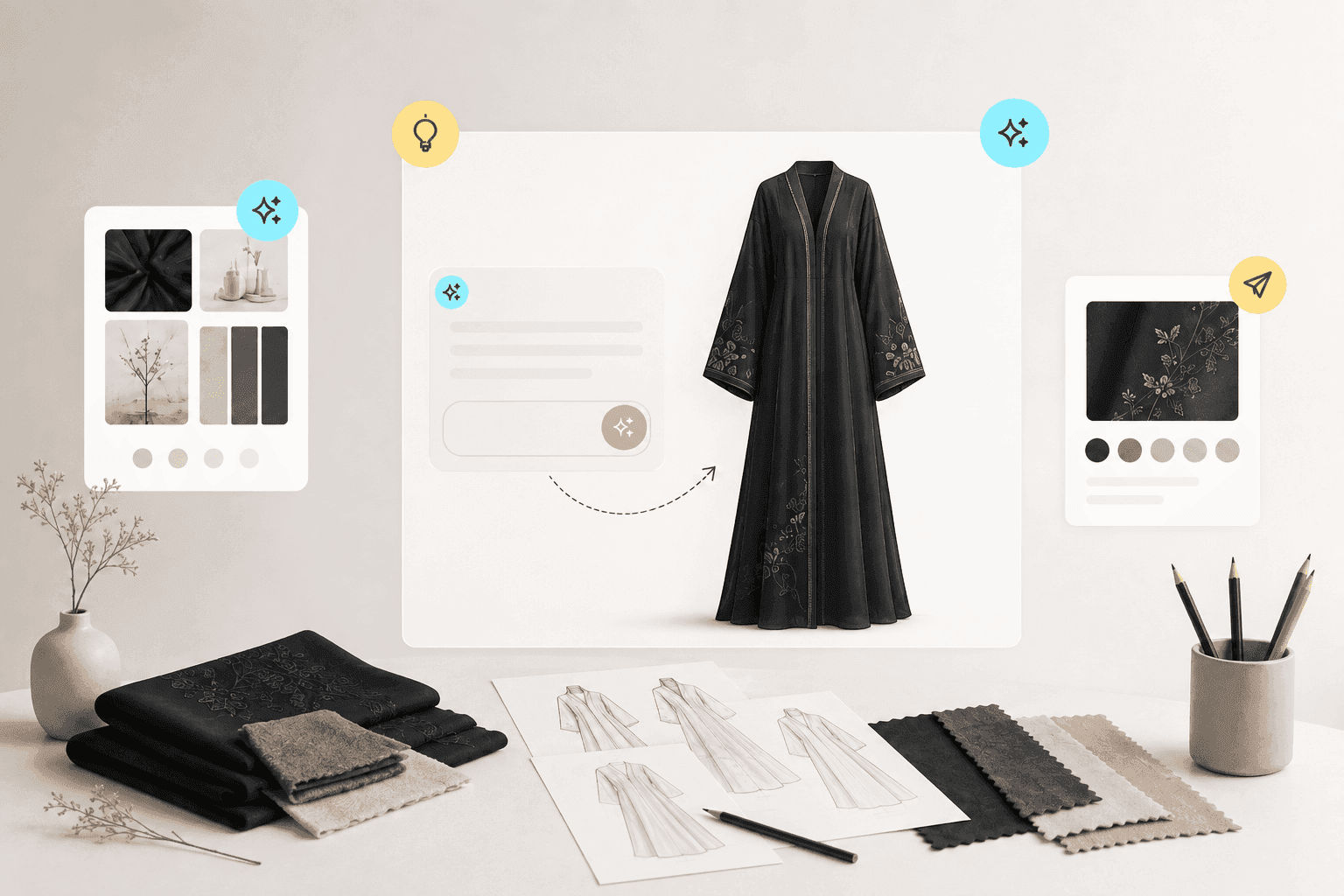
Use AI to clarify the direction, not to replace specifications and physical sampling.
It can also be used to build a consistent mood board for the collection. If you want five abayas to share a single identity, you can first define a shared visual universe of colors, fabrics, cuts, and details, and then develop each piece within it.
However, do not ask it for decisions that it cannot resolve from the image alone. Do not rely on it to determine precise fabric consumption, adjust patterns and measurements, verify fabric movement on the body, or calculate production costs. These decisions must later transition to the designer, tailor, workshop, and the physical sample.
How do you write a prompt that gives you a visualization closest to what you want?
The difference between "design a luxurious abaya" and a scalable description is the number of decisions you resolve before asking for the image.
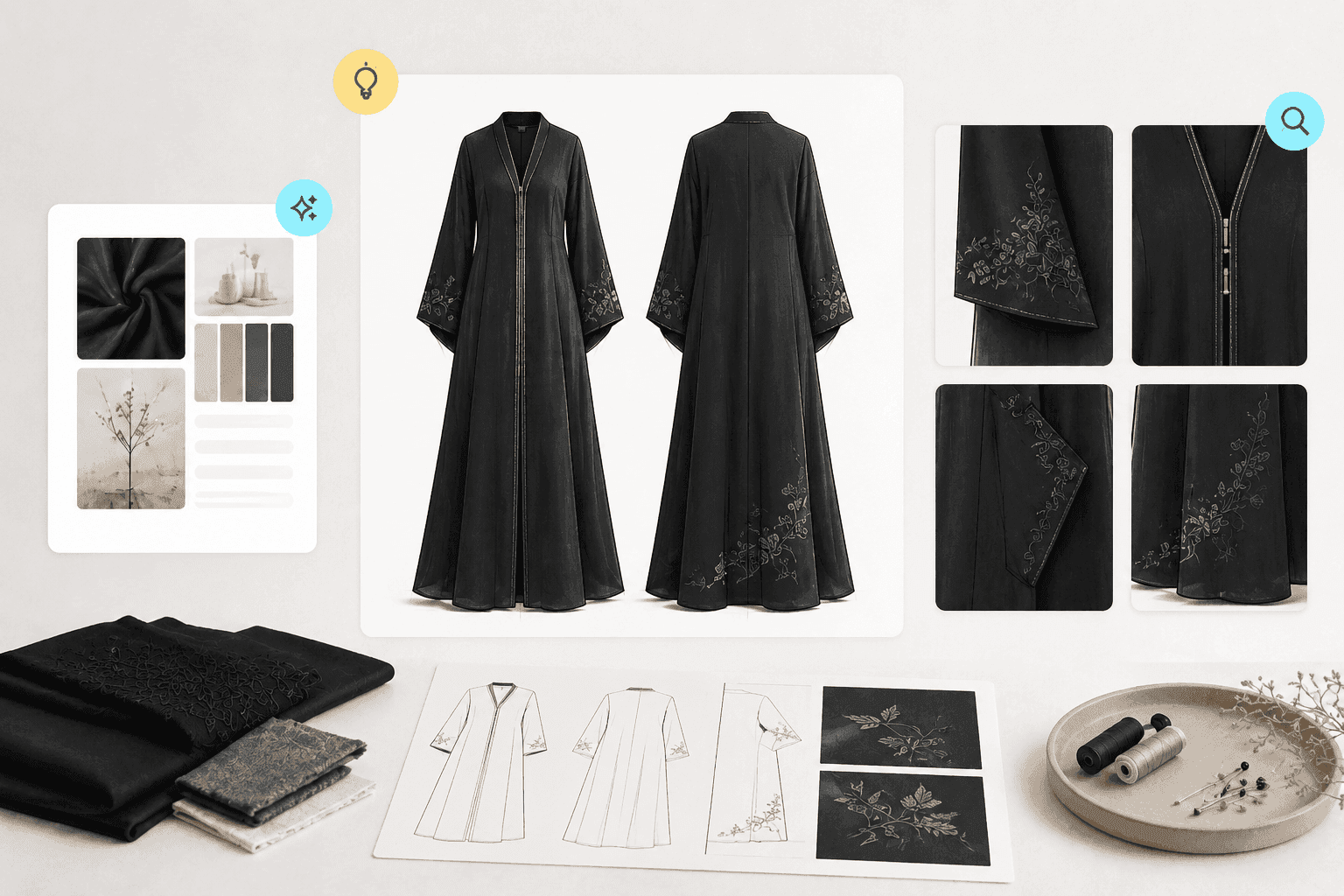
Organize the use, cut, fabric, and details into one clear description.
Use this simple equation:
Use + Cut + Fabric + Color + Sleeves + Closure + Pockets + Details + Impression + Presentation style
Instead of:
Design a luxurious black abaya.
The prompt can become:
Create a visual concept of a daily abaya suitable for work, with a straight and comfortable cut, made of medium-weight black fabric with a slight drape, with slightly wide sleeves, hidden side pockets, and a simple front closure, featuring quiet black embroidery on the sleeve edges only. The design is practical, modern, and not overdone in its details. Display the abaya from the front and back on a neutral background, without people, logos, or text.
The second prompt does not guarantee that the result is sewable, but it gives the tool less room to invent key decisions for you.
A ready-to-use template for visualizing your abaya with AI
You can use the following template as a starting point, then modify it according to the product:
Create an initial visual concept of an abaya dedicated to [work / daily / travel / occasion].
Target customer: [brief description of need and taste].
Cut: [straight / wide / cloche / other].
Fabric: [material or its attributes in terms of weight, drape, and transparency].
Color: [primary color and additional colors].
Sleeves: [shape, length, and details].
Closure: [open / buttons / zipper / snap buttons].
Pockets: [present or absent, and their location].
Embroidery or additions: [detail and location].
Impression: [practical / quiet / luxurious / modern].
Display the abaya from the front and back on a neutral background, without a model, people, logos, or text.
Do not treat the template as a rigid formula. For example, if the most distinctive feature of the design is the sleeve, describe it in greater detail. If the fabric is the primary element, give the tool more information about its texture, weight, and drape.
Do not accept the first beautiful image
Here lies a very easy mistake: a beautiful result appears, and you treat it as if the design is complete.
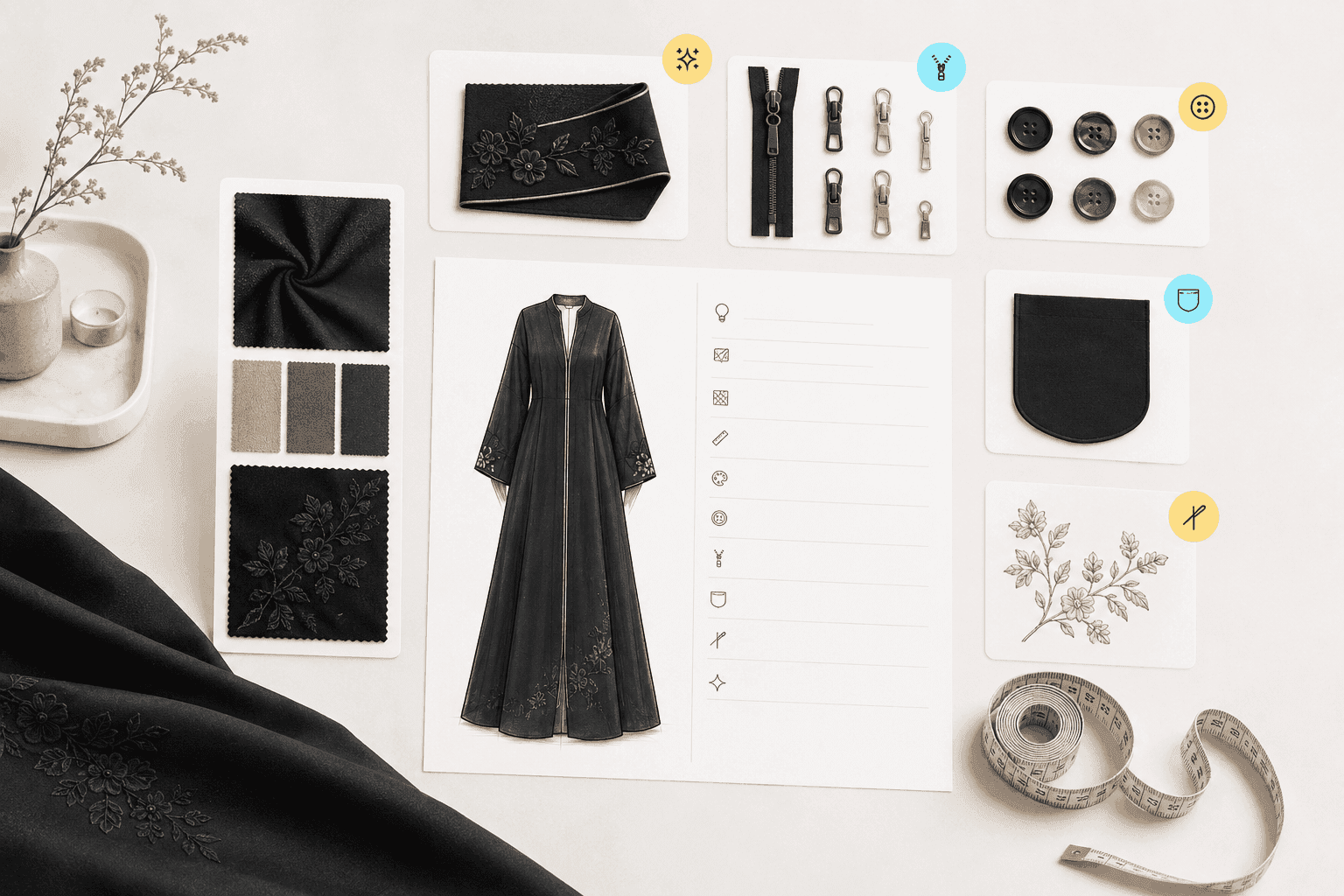
Modify one element at a time until the design direction is locked.
It is better to look at the first results as drafts. Choose the direction closest to your idea, and then start modifying it.
It is also best to edit one variable at a time. If you change the cut, color, sleeve, and embroidery in the same prompt, you might get an entirely new image and won't know which edit improved the design and which ruined it.
The journey could look like this: tone down the embroidery → widen the sleeve slightly → make the pockets hidden → show the back → show the sleeve detail close up.
After several rounds, you will reach a more consistent visualization that you can use as a reference instead of a collection of contradictory images.
Test the design as a product, not as a picture
Before adopting the concept, step away for a moment from the beauty of the image and ask how the abaya will function in real life.
If it is for work, are the sleeves practical for movement and tasks? If you added a pocket, is its position logical? If the embroidery is heavy on the sleeve edge, what will happen during use? And if the cut is very wide, how will that affect fabric consumption and cost?
Then ask the business question as well: can this abaya be produced at the price the brand can sell it for?
AI might generate beautiful details, but they might require hours of embroidery, a massive amount of fabric, or complex execution that drives up the cost. This is why you should not adopt a design just because it looks attractive on screen.
Turn the image into a spec sheet that the manufacturer understands
When you reach a concept you like, do not just send the image to the tailor and say: "I want something like this."
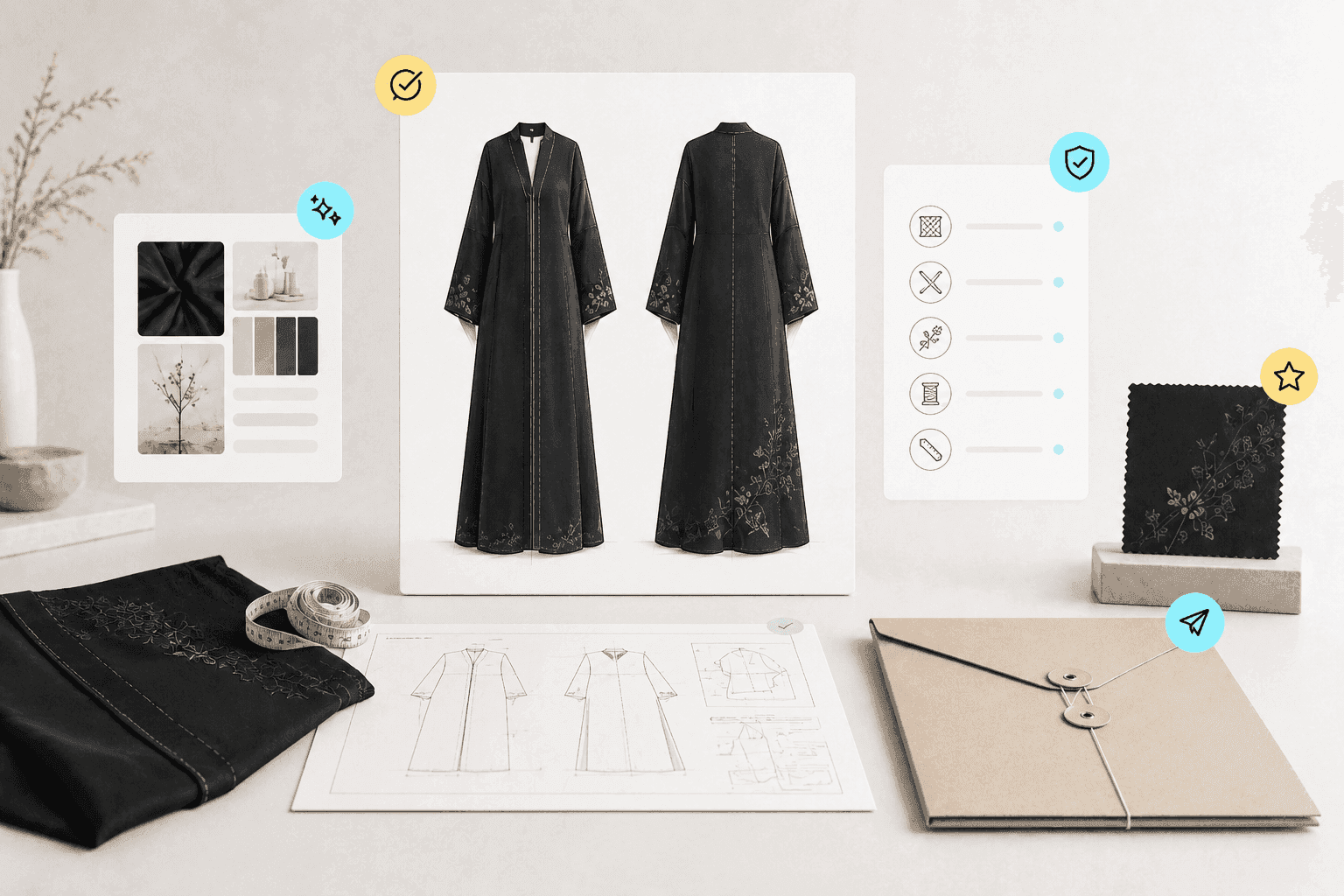
The image is a visual reference, and the spec sheet is the execution reference.
The image is a visual reference, but execution requires written information.
Prepare a specification sheet detailing the fabric type or code, weight, drape, and transparency, along with basic measurements such as length, chest, shoulder, sleeve, and armhole, in addition to the closure type, pockets, lining, belt, embroidery, location of each detail, and finishing method.
If there is embroidery, do not just rely on its appearance in the image. Specify its size, position, and the distance from which it starts. If the sleeve is the main element of the design, add a close-up shot of it with measurements.
The idea is to minimize as much as possible what the manufacturer has to guess from the image.
When do you need an abaya designer?
If your idea relies on a new cut, requires a pattern, needs a sizing system developed, or if you are preparing for bulk production, this is where the value of a specialized designer becomes apparent.
Send them the concept you reached, the prompt, the references, and the initial spec sheet, and then ask for a feasibility review. They might discover that a beautiful detail in the image will not work with the chosen fabric, or that the cut needs modification to drape and move better.
AI here does not compete with the designer; rather, it can make the dialogue with them faster because you approach them with a much clearer idea.
The sample is the true test of the design
After the visualization and specifications comes the most important test: make a single sample before production.
Use the actual fabric you have in mind, and then test the abaya by moving in it, not just by looking at it. Observe the length, the fabric drape, shoulder comfort, sleeve movement, pocket placement, closure, embroidery, and finishing.
Also test caring for the piece if that is important for the fabric: what happens after washing or ironing? Does the color or drape change? Does the product need special care instructions that the customer should know?
The final result might be slightly different from the image created by AI, and that is normal. The goal was not to copy the image literally, but to use it to reach a better, real abaya.
How do you use AI to design an entire collection?
If you are developing more than one abaya, do not start each design from scratch. First, define the shared rules of the collection: the color palette, types of cuts, level of detail, fabrics, and what makes the pieces look like they belong to the same brand.
After that, give each abaya a different role. You might have a basic daily piece, another for work, and a third with a grander presence for occasions, while keeping a shared design language among them.
In this way, AI helps you see the collection as one family before you invest in making multiple samples.
Do not let AI copy another brand
It can be tempting to give the tool the name of a well-known brand and ask to "design an abaya for me in the same style," but it is better to build your brand's language from your own characteristics.
Describe what you like: clean cuts, quiet colors, geometric embroidery, wide sleeves, draping fabrics… instead of asking for a copy of another brand's product or identity.
And review the results before adopting them, especially details and ornaments, so that you do not transition from inspiration to unintentionally copying a known design.
From concept to product in the abaya store
After approving the sample, an entirely different phase begins: calculating the piece's cost, setting the price, preparing the sizes, photographing the product, writing fabric and care information and details, then adding it to the collection and displaying it in the store.
Here you can use Salla to build the commercial side of the journey; from creating the fashion store and displaying products and their options to managing orders, inventory, and other tools available for the fashion sector.
The important thing is that the journey does not stop at a beautiful image generated by artificial intelligence. The value of the tool becomes clear when it helps you make faster decisions, and then these decisions turn into a good sample, a sellable product, and a clear experience for the customer.
Checklist before sending the abaya design for execution
Have you defined the abaya's use and target customer?
Have you defined the cut, fabric, colors, and basic details?
Have you developed a single direction instead of combining details from different images?
Do you have a front and back view, and close-ups of important details?
Have you written the measurements, fabrics, and finishes on a separate sheet?
Have you reviewed the design's feasibility and cost?
Have you ensured that the design does not copy another product or brand?
Will you make a sample and test it before production?
Frequently Asked Questions about designing abayas with AI
Is an AI image enough for the tailor?
No. The image helps clarify the direction and shape, but execution requires measurements, fabric, and written details, and it may need a pattern and review by a designer or specialized tailor. After that, a sample remains essential to test the actual result.
Can an entire abaya collection be designed using AI?
It can be used to visualize the collection, unify its visual direction, and quickly test multiple ideas, but each piece needs an independent review of fabric, measurements, cost, and feasibility before production.
What is the best program for designing abayas with AI?
There is no single tool that is best for all cases. Look for a tool that allows you to generate and edit images while maintaining your chosen direction as much as possible. The quality of the result also depends on the clarity of your idea and how you develop it, not on the name of the tool alone.
Can AI be relied upon instead of a fashion designer?
It can reduce the time required to explore and visually communicate ideas, but it does not replace skills related to pattern making, sizing, fabrics, drape, and production. The closer you get to actual execution, the more important human expertise and sampling become.
Can I use the image generated by AI as the product image in the store?
It is best to show the customer the actual product they will receive, especially since the image affects their expectation of the fabric, cut, color, and details. Use AI images in the visualization phase, then photograph the actual sample or product after it is approved.
Continue building your abaya brand
After adopting the design, move on to choosing the appropriate abaya fabrics, and
compare tailoring, production, and wholesale purchasing, then prepare the product page with the measurements, fabric, and photos that the customer needs before buying. In this way, AI tools become a part of the product development journey, not a separate stage from it.
Sources and Resources
Salla — Fashion Sector Solutions
How to Build a Growing Abaya Store? 5 Lessons from the (Al-Alia) Abayas Experience
6 minutes read

Wholesale abayas for businesses and retailers: A guide to building a B2B sales channel
10 minutes read
From Selling on Instagram and WhatsApp to an Abaya Store: A Transition Plan Without Losing Your Customers
10 minutes read
Mohammed Al-Anazi
Product Manager at Salla
49
Article
Featured author

E-commerce
How to Build a Growing Abaya Store? 5 Lessons from the (Al-Alia) Abayas Experience
Al-Alya’s experience shows that growing a fashion store is not just about attracting more traffic. Sustainable growth comes from improving the entire customer journey: reducing hesitation, recovering abandoned carts, offering relevant promotions, simplifying payment, and continuously optimizing the shopping experience.
6 minutes read
Arwa Abdulkarim

Fashion
Wholesale abayas for businesses and retailers: A guide to building a B2B sales channel
Start selling abayas wholesale with a clear offer built for a specific customer segment, including your catalog, order quantities, pricing, samples, and delivery terms. Test demand with a focused approach before expanding your wholesale channel.
10 minutes read
Mohammed Al-Anazi

Fashion
From Selling on Instagram and WhatsApp to an Abaya Store: A Transition Plan Without Losing Your Customers
Maintain your accounts and relationship with female customers, and gradually transition abaya selection, payment, and shipping address to the store. Start with clear products and test demand before expanding the launch.
10 minutes read
Mohammed Al-Anazi
Fashion
How to move your abaya shop online and manage inventory for both channels together?
Start by auditing every model, size, and color, and unifying the codes; then test the integration of the cashier and the store, as well as the cancellation and exchange procedures. Expand after stabilizing inventory and fulfillment.
11 minutes read
Mohammed Al-Anazi