6 min read

Arwa Abdulkarim
Product Marketing Manager
Would you like to read a summary of the article?
Summarize with ChatGPT
Summarize it with Claude
Summarize it with Perplexity

You have been standing in front of the perfume shelf for ten minutes. You are not in a rush, but you are not completely comfortable either. You have picked up the bottle twice and put it back three times. You genuinely like the fragrance, but the problem is not the scent itself. It is the question running through your mind: what if I like it today and regret it a week from now? What if I spend this much and later realise I was simply more excited about it than I should have been?
In that moment, you are not thinking only about the product. You are thinking about everything that might happen after you buy it: the possibility of regret, the money you could lose, and that frustrating feeling of realising you made the decision too quickly. Then, just as you hesitate one last time, you notice a small card next to the price: “Returns accepted within 14 days.”
Strangely, nothing about the perfume has changed. The price is the same, the fragrance is the same, and even your opinion of it has not changed very much. What has changed is how you feel about the decision. Suddenly, buying no longer feels like an irreversible leap. It feels like a decision you still have some control over. You can try it, see how you feel, and decide later whether it was really the right choice. The worst possible outcome is no longer simply losing the money, because you know the decision is still partly in your hands.
We are not always looking for another reason to buy
We experience this more often than we realise. Before booking a hotel, we check the cancellation policy. Before buying a new phone, we ask about the warranty. Even when trying a restaurant for the first time, we can spend far too long reading reviews written by people we have never met.
On the surface, it looks like we are searching for more information. In reality, we are often searching for something else entirely: reassurance, and that quiet feeling that tells us the decision is still under our control.
This is why people do not always buy because they are completely convinced. Sometimes, they buy because they feel reassured enough. There is a big difference between a store that effectively tells you, “Once you pay, there is no going back,” and one that says, “Try it. If it is not right for you, return it.” The product may be identical and the price may be identical, but the feeling the customer walks away with is completely different.
The fear is not always about the product
In consumer behavior, perceived risk describes the uncertainty a person feels when considering a purchase. A customer is not evaluating the product alone; they are also evaluating what they could lose if the decision turns out to be the wrong one.
That is where return policies become important. When customers know they can return a product under clear conditions, part of the risk they imagine before buying becomes less severe. The product has not suddenly become better, but the potential cost of making the wrong decision feels smaller.
And this is the important part: a customer does not necessarily need to use the return policy for it to influence their decision. Sometimes, simply knowing the option exists is enough.
Customers do not buy while planning to return the product, but knowing they can often makes the decision feel safer
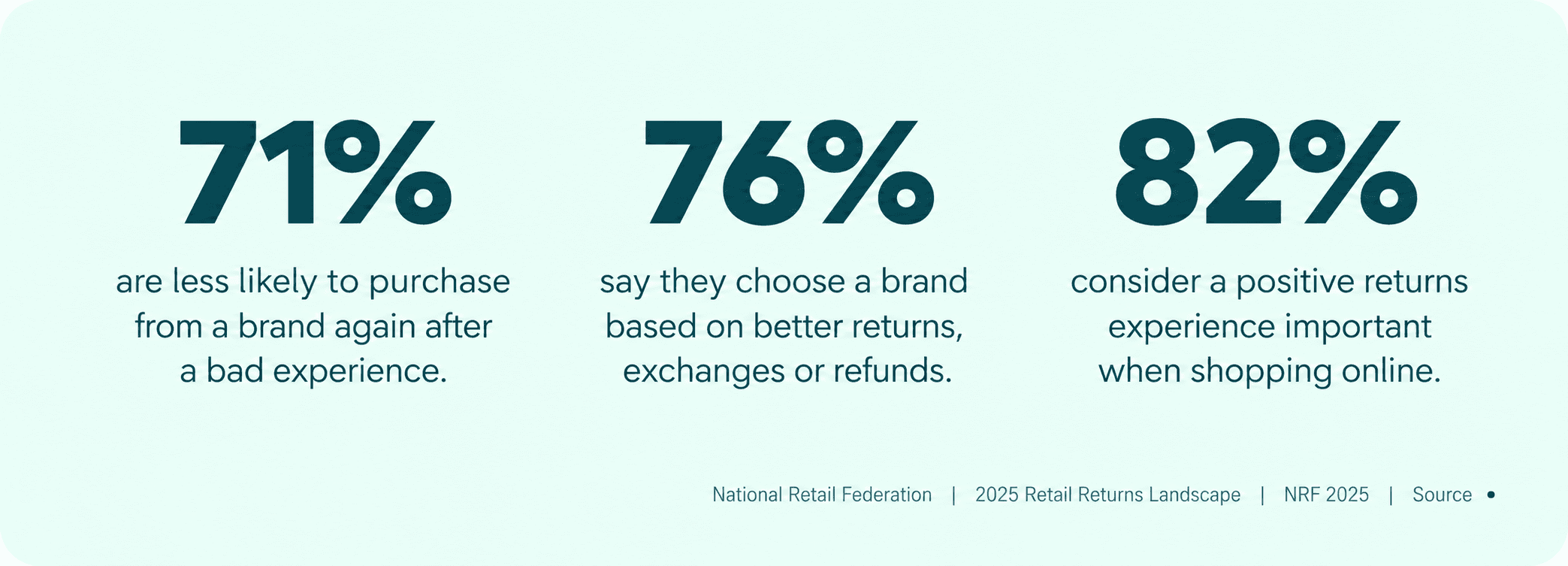
But “return it if you don’t like it” is not the whole story
Imagine a store tells you, “Returns are accepted within 14 days.” That sounds reassuring, but what happens next? Do you have to ship the product to another city? Do you need to complete a long form? Will you wait weeks before the money reaches your account again? Can you return it at your nearest branch?
This is where the clarity and ease of the return process become part of the shopping experience itself. Having the right to return something on paper is one thing. Feeling confident that returning it will actually be easy if you need to is something else.
That is why a line such as “Return your product within 14 days at any branch” communicates more than a policy. It tells customers when they can return the item, removes some of the uncertainty around where and how the process works, and reassures them that their money is not locked into a decision they cannot reverse.
That can be the difference between a customer adding the product to their cart and one saying, “I’ll think about it and come back later.”
The sentence good salespeople understand instinctively
What is interesting is that salespeople understood what we now call “perceived risk” long before they needed a term for it. They learned it by spending enough time standing in front of customers and noticing the moment when someone picked up a product and put it back down, asked for the price again, or said, “I’ll think about it and come back.”
That is how one of the most familiar sales lines became so powerful: “Take it. If it doesn’t suit you, bring it back.”
The salesperson may never have known they were reducing perceived risk, or that they were giving the customer back a sense of control over the decision. They simply learned through experience that a hesitant customer does not always need more persuasion. Sometimes, they just need to know that buying does not mean the decision has been taken out of their hands.
What does this mean for your store?
If you sell through an online store, do not treat your return and exchange policy as a legal page you add at the end of building your website, or as text you include simply because you are expected to have it. Treat it as part of the shopping experience itself.
Ask yourself whether customers can understand within seconds when they are allowed to return something, how they start the process, where the product needs to go, and whether the policy feels like it protects both sides rather than only the store.
The clearer those answers are, the less the customer has to imagine for themselves. And that matters, because gaps in information rarely stay empty for long. Customers often fill them with the worst-case scenario.
Sometimes, a customer does not need another discount, another feature, or ten more messages persuading them to buy. They simply need one less reason to hesitate.
Sources
Mitchell, V.-W. (1999), Consumer perceived risk: conceptualisations and models.
How to Build a Growing Abaya Store? 5 Lessons from the (Al-Alia) Abayas Experience
6 minutes read

Wholesale abayas for businesses and retailers: A guide to building a B2B sales channel
10 minutes read
From Selling on Instagram and WhatsApp to an Abaya Store: A Transition Plan Without Losing Your Customers
10 minutes read
Arwa Abdulkarim
Product Marketing Manager
11
Article
Featured author

E-commerce
How to Build a Growing Abaya Store? 5 Lessons from the (Al-Alia) Abayas Experience
Al-Alya’s experience shows that growing a fashion store is not just about attracting more traffic. Sustainable growth comes from improving the entire customer journey: reducing hesitation, recovering abandoned carts, offering relevant promotions, simplifying payment, and continuously optimizing the shopping experience.
6 minutes read
Arwa Abdulkarim

Fashion
Wholesale abayas for businesses and retailers: A guide to building a B2B sales channel
Start selling abayas wholesale with a clear offer built for a specific customer segment, including your catalog, order quantities, pricing, samples, and delivery terms. Test demand with a focused approach before expanding your wholesale channel.
10 minutes read
Mohammed Al-Anazi

Fashion
From Selling on Instagram and WhatsApp to an Abaya Store: A Transition Plan Without Losing Your Customers
Maintain your accounts and relationship with female customers, and gradually transition abaya selection, payment, and shipping address to the store. Start with clear products and test demand before expanding the launch.
10 minutes read
Mohammed Al-Anazi
Fashion
How to move your abaya shop online and manage inventory for both channels together?
Start by auditing every model, size, and color, and unifying the codes; then test the integration of the cashier and the store, as well as the cancellation and exchange procedures. Expand after stabilizing inventory and fulfillment.
11 minutes read
Mohammed Al-Anazi