15 min read

Mohammed Al-Anazi
Product Manager at Salla
Would you like to read a summary of the article?
Summarize with ChatGPT
Summarize it with Claude
Summarize it with Perplexity
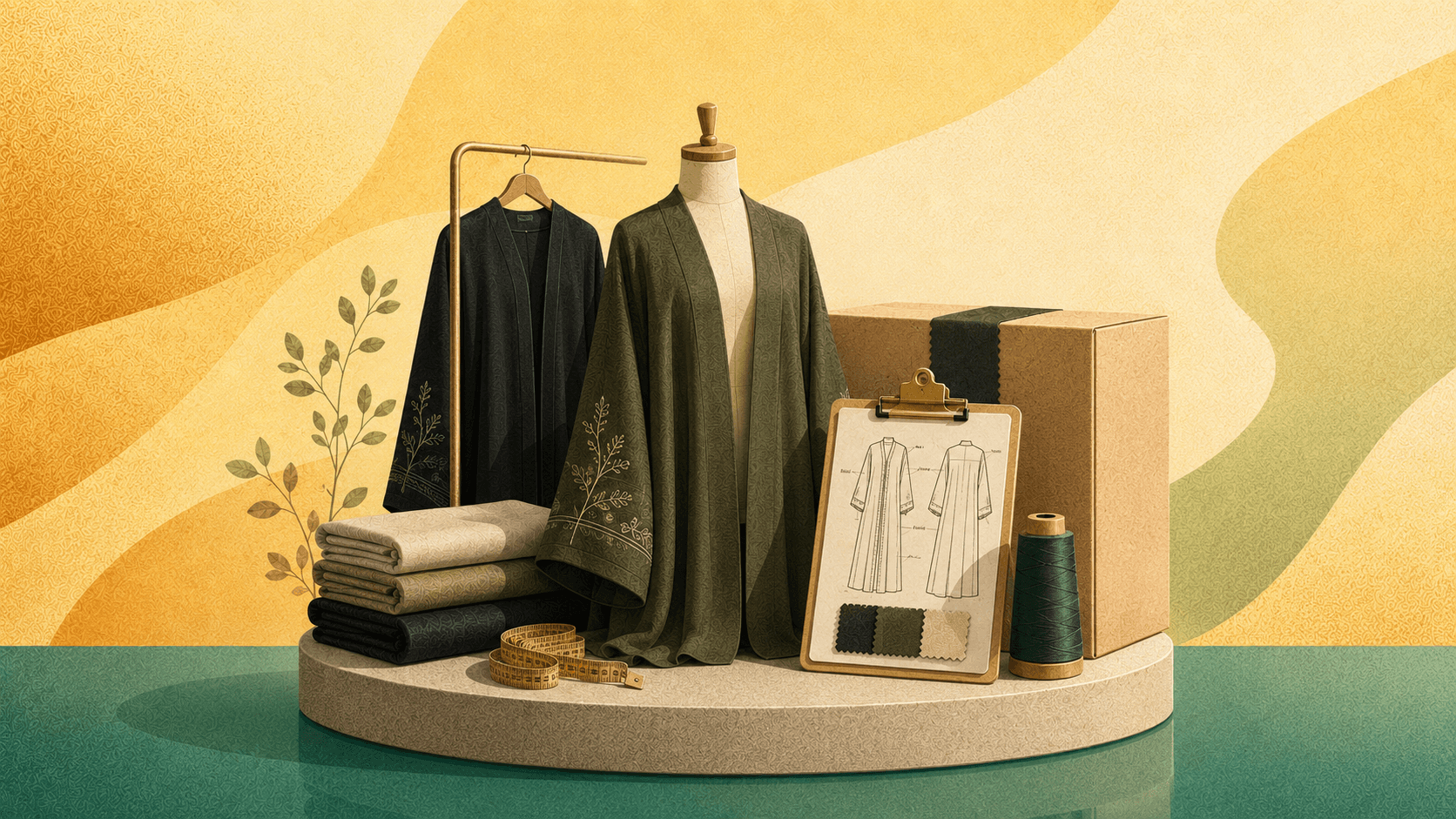
After choosing the appropriate abaya design and fabric, comes a decision that may define the entire shape of the project: Do you tailor the abayas upon receiving the order? Or do you buy ready-made models and sell them? Or do you produce your own design in a pre-ordered quantity?
The decision may initially seem related to price, but it is much broader than that. The model you choose affects how much money you will put into inventory, the speed of delivery to the customer, your ability to offer a unique design, your control over sizing and quality, and even the number of orders you can handle when the store starts to grow.
Therefore, do not look for "the best way to produce abayas" in absolute terms. Look for the model most suited to your project stage right now, then allow it to change as demand grows.
First: Understand the abaya production models available to you
There are three main models, with many areas for combination and experimentation between them.
Made-to-order (custom tailoring) means that the execution of the abaya starts after the order arrives, or that part of it is customized according to size, length, or customer choice. This gives you greater flexibility and reduces the need to store large quantities of the final product, but it requires a precise operational process and can result in longer delivery times.
Buying ready-made abayas means choosing designs from a supplier or wholesaler and selling them in your store. This is a faster route to testing the market, but it gives you less control over the design, and you may find the same or similar products in other stores.
As for private production, it means developing your own design and specifications and then producing a quantity of it at a tailor, workshop, or factory. Here you gain greater control over the identity of the product, but you need relatively more capital, and you deal with decisions regarding samples, quantities, inventory, and quality control.
You do not need to choose just one model forever. You may start with ready-made items, then move some successful products to private production. You might also keep a core collection ready for delivery while offering some designs made-to-order. The important thing is to know why you are using each model.
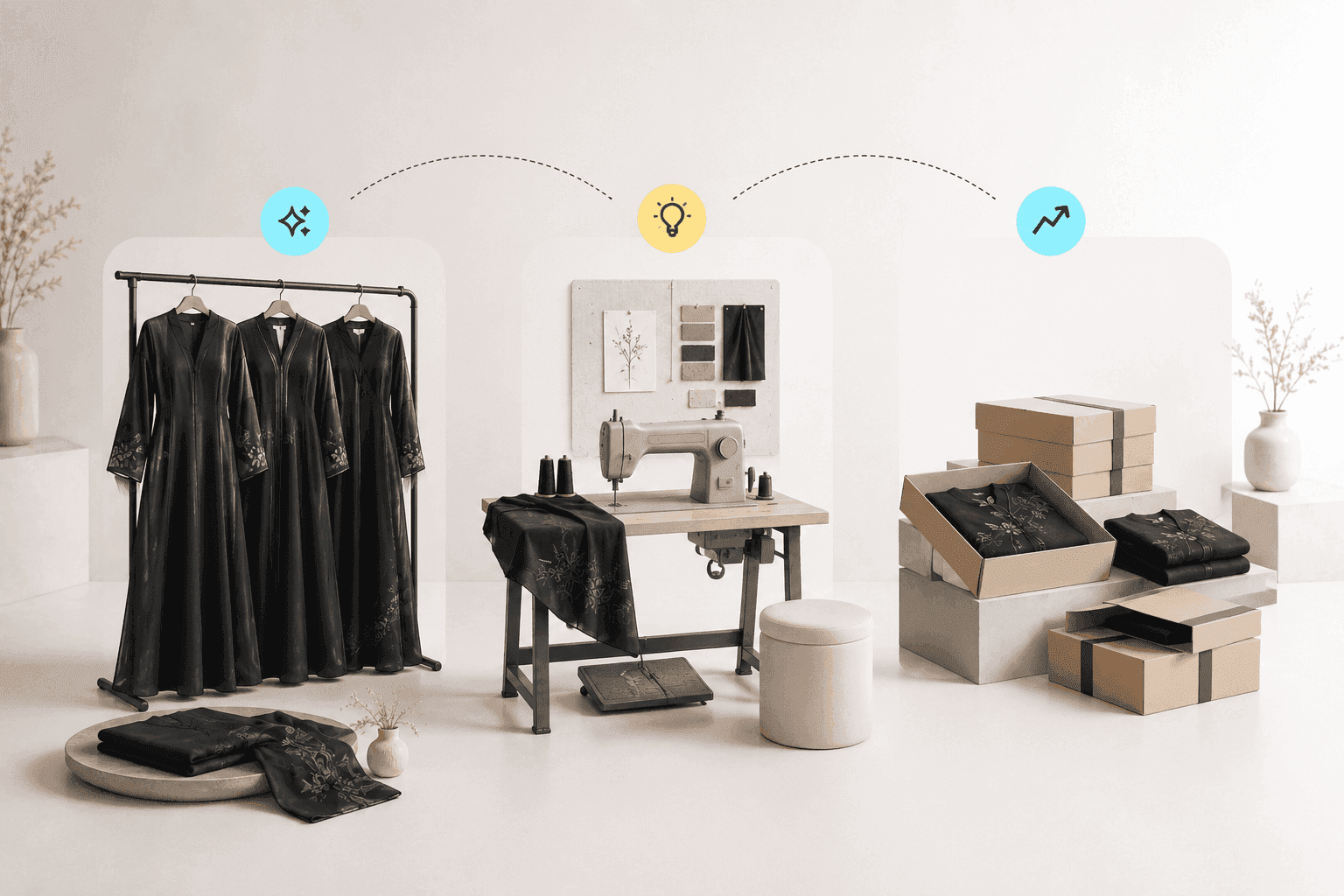
Compare the speed of ready-made, the flexibility of custom tailoring, and the capability of private production.
Model | When does it benefit you? | What needs your attention? |
|---|---|---|
Made-to-order | When the value of the abaya relies on size or customization | Execution time and sizing accuracy |
Buying ready-made | When you want to test sales quickly | Similarity of products and re-supply feasibility |
Private quantity production | When demand is proven and you want a clearer identity | Capital, inventory, and minimum order quantity (MOQ) |
When is buying ready-made abayas right for you?
If your idea is still new and you do not yet know what the customer will actually buy, ready-made can help you test the market without building a full production process from day one.
You can try a limited number of cuts, colors, and sizes, and then monitor what moves faster: Are loose cuts selling more? Which lengths are repeated? Is there a color driving demand? And which models remain in stock?
But the ease of buying ready-made does not mean buying a large quantity from the first supplier. Order samples of the sizes you will sell, inspect the fabric, stitching, finishing, and actual measurements, and compare more than one piece of the same model if you can. Ask the supplier a highly important question: Can I re-order the same design after the stock runs out?
A model might succeed in your store, only for you to discover that the supplier cannot provide it again, or that the next batch came with a different fabric, color, or measurements.
There is another challenge: differentiation. If the supplier sells the same design to dozens of stores, what will make the customer buy it from you? Here, differentiation shifts from the product alone to the curation of the collection, how it is styled and photographed, the service, the packaging, the store experience, and building the brand around it.
When is custom-made-to-order abayas right for you?
Made-to-order tailoring becomes more attractive when the value of the product is linked to customization: a specific length, a modification in size, a choice of embroidery or color, or a cut you do not want to produce in large quantities in advance.
The advantage of this model is that you do not necessarily need to store all sizes and designs as finished products. However, you swap part of the inventory risk for greater operational complexity.
Every order must reach the person executing it with the correct information: design, length, size, fabric, modification, embroidery, and delivery date.
Here, the important question becomes: what happens if ten orders arrive in one day? What if they become fifty?
If every order requires a WhatsApp message, manual review, and a new explanation to the tailor, the model may work with the first few orders but becomes exhausting with growth.
Therefore, before launching made-to-order, try the entire journey yourself: the customer enters, selects the options, the order reaches the team, the specifications are understood without extra questions, the abaya is executed, undergoes inspection, then is packaged and shipped within the promised period.
Any unclear information in this journey will likely turn into a question, a delay, or a product error.
When does private production make sense?
Private production becomes more attractive when you start to know what actually works. You have a design with proven demand, sizes that have become clearer, a fabric you have approved, a price you can sell at, and a better idea of the quantity that can move.
Here you can produce a custom batch instead of executing each piece individually. The advantage is not only lowering the unit cost when quantity increases; more importantly, you can have greater control over the cut, fabric, details, finishing, and build a product linked to the brand name itself.
In return, however, inventory risk begins.
If the minimum production quantity is 100 pieces, for example, it is not enough to know the cost per piece. You need to know: How much will you pay before sales start? How many pieces do you expect to sell? In how many months? And what happens to cash flow if only half of the quantity moves?
Here, data from your previous sales becomes more important than enthusiasm for the new design.
Can you combine the three models?
Yes, and in many cases, this might be smarter than forcing the entire project into one model.
You can start with a small collection of ready-made abayas to test demand, along with one or two designs exclusive to your brand. If repeated demand appears for a specific design, you can later move it to private production.
You can keep the most requested sizes ready for shipping, while providing less common lengths or modifications on a made-to-order basis.
The approach can also vary between collections. The core collection running throughout the year may suit pre-production, while a design linked to a fast trend might start with a limited quantity, and a high-priced piece with many options might make more sense as made-to-order.
The idea is that the production model is a tool for managing risk and demand, not a fixed brand identity.
You can view the abaya store solutions on Salla. And if you are starting from the concept phase, check the guide to building an abaya brand. For serving merchants and businesses, head over to the B2B wholesale abaya selling guide.
Before looking for a factory or tailor, prepare the abaya you want on paper
A common mistake is sending a photo to multiple places and then asking: "How much to make this?". If each party understands the image differently, you are not actually comparing prices for the same product.
Before requesting a price, prepare a brief file outlining the cut, fabric, color, sizing, sleeves, closure, pockets, placement of embroidery or additions, and the required finishing method.
If you have worked on visualizing the abaya using AI, the image can be a useful visual reference, but it does not replace the specifications needed by whoever will execute the product.
The more you send the exact same specifications to the parties you are comparing, the fairer the comparison of price, quality, and time becomes.
What should an abaya specification sheet include?
A clear name or code for the design inside the store.
A front and back sketch or visualization, and close-up photos of important details.
The fabric code that you adopted in your fabric library, the color, and its source if specified.
Measurements for each size, such as abaya length, sleeve, shoulder, bust, and any measurements affecting the cut.
The type of closure, lining if any, pockets, embroidery, and accessories.
The method of finishing, ironing, and packaging.
Acceptable limits of variation in measurements and color.
This sheet protects both parties from the phrase "this is what we understood." Manual or industrial production may result in slight variation, but you need to agree in advance on the limit beyond which you consider the piece non-conforming.
The sample is not a formal step before production
Whether you deal with a tailor, workshop, or factory, do not move directly from design to quantity. Start with a sample.
Wear the abaya or try it on the target size, and look at the movement, drape, length, sleeves, closure, pockets, and embroidery. Also, test the fabric after caring for it in the way you will recommend to the customer, then record the adjustments in writing.
Instead of "widen the sleeve a bit," write the required measurement. Instead of "the embroidery should be higher," specify its position. The more your opinion turns into a measurable specification, the easier it is to replicate the result.
After adjustments, approve a final reference sample and keep it.
When production arrives, do not compare it to your memory or a photo on your phone; compare it to the sample you approved.
How do you choose an abaya factory, tailor, or supplier?
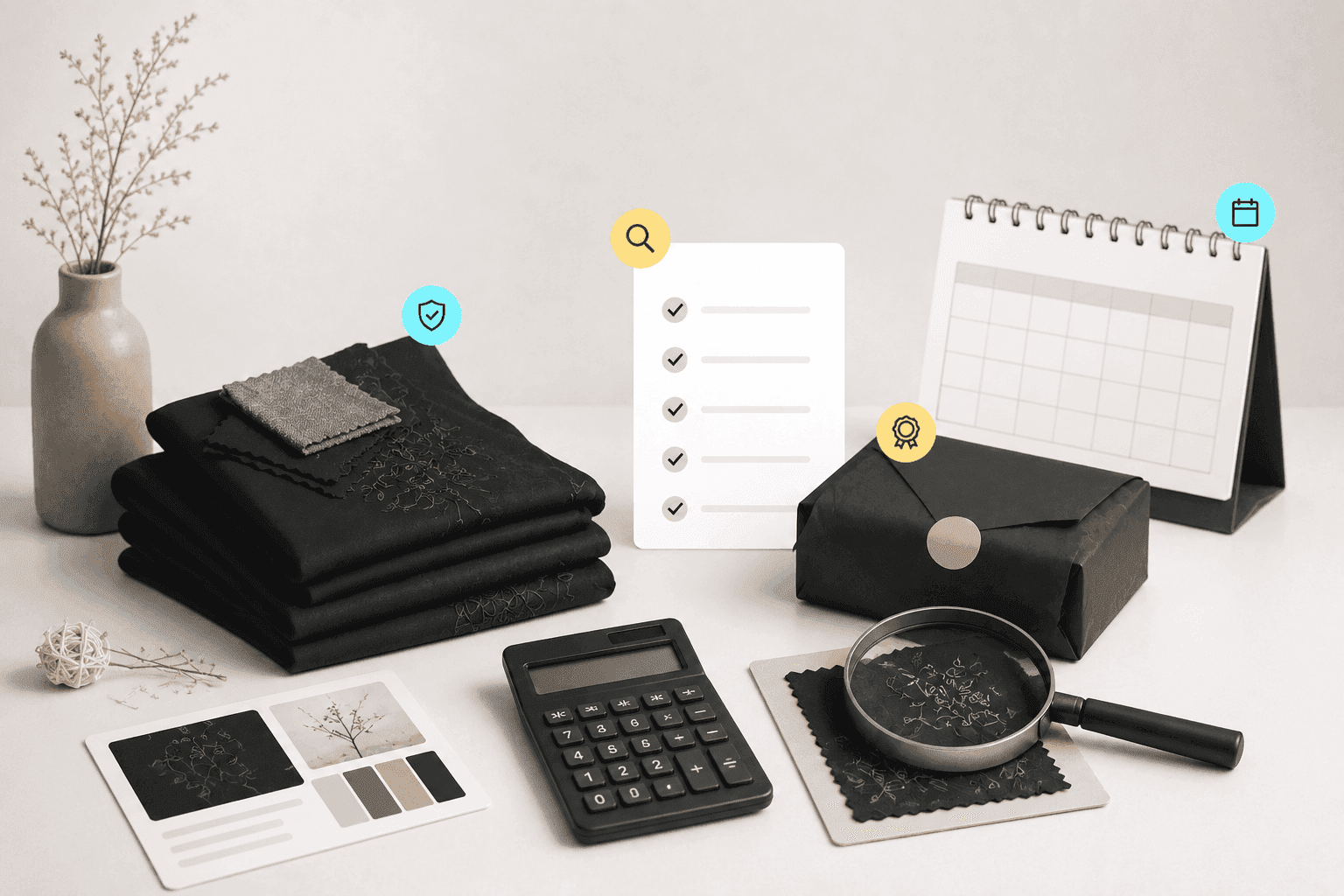
The sample, specifications, and timeframe are more important than a verbal promise.
Price is part of the decision, not the entire decision. Start by asking the provider about the type of work they usually execute; a provider excellent at producing large quantities is not necessarily the most suitable for tailoring a single custom-made piece, and vice versa.
Then evaluate them on several aspects: sample quality, commitment to specifications, clarity of communication, minimum order quantity, execution timeframe, production capacity, ability to replicate the same result, and policy for dealing with defects.
And ask what happens during seasonal pressure as well. A factory that can execute your order in two weeks during a quiet month might need a different duration before Ramadan or Eid.
If you rely on a specific fabric, make sure to find out who is responsible for providing it. Do you buy it and send it? Or does the factory provide it? If they provide it, how do you make sure it is the same fabric in every batch?
For an initial search for fabrics and suppliers, you can explore Al-Ammari Fabrics, Al-Hatami, Kayan, and Taqi. For manufacturing or wholesale, you can explore Fakhr Al-Naseej, Black Boutique, and Moistreet. These entities are for exploration and comparison, not a recommendation or endorsement by Salla.
You can also use the Salla Supplier Selection and Evaluation Tool to organize the process of comparing options.
Do not just compare the price per piece
A supplier may offer you a ready-made abaya for 100 SAR, while a factory tells you that producing your design will cost 85 SAR. This does not automatically mean that private production is cheaper.
Calculate the cost of the abaya reaching a retail-ready state.
In private production, the cost of fabric, cutting and tailoring, embroidery and additions, samples and modifications, packaging, transport, waste, and defective pieces may be included. The cost of developing the sample can be distributed over the produced quantity instead of ignoring it.
As for made-to-order, there is an additional operational cost in receiving measurements, modifications, and following up on each order individually. In ready-made, think about shipping, re-supply, and the potential of changing the supplier or the design running out, not just the purchase price alone.
In all models, ask the same question: How much does the abaya actually cost me when it is ready to reach the customer?
Do not forget the cost of inventory
Pre-production may lower the unit cost, but it turns part of your money into pieces waiting to be sold.
Imagine that producing one abaya costs you 120 SAR, and the minimum production quantity is 100 pieces. This means you will put 12,000 SAR into the product before adding the rest of the project costs.
If you sell the quantity quickly, the decision could be excellent. But if half of it remains for several months, part of your capital will remain tied up in inventory.
For this reason, factors such as season and trend must also enter into the production decision. A basic design that you can sell all year round is different from a winter abaya or a trending color that you expect to have a short window of demand.
The shorter the sales window, the more costly a mistake in estimating quantity becomes.
How to choose the starting model?
Project Status | Closest Starting Point | First Test |
|---|---|---|
New idea and limited budget | Samples, small quantity, or limited custom tailoring | Can you deliver the product in the same quality and timeframe? |
Want to test the market quickly | Small quantity of ready-made abayas | Are the cut and size sales repeated? |
Design with proven repeated sales | Private production in a calculated quantity | Does the demand cover quantity, time, and capital? |
Varying demand | Hybrid model | Which designs remain ready-made and which are custom tailored? |
You are not required to predict the final shape of your project from the start. You are required to choose the lowest risk model that allows you to learn what you need to know right now.
Checklist before a large order from a supplier or factory
☐ The manufacturing party received written specifications and not just an image.
☐ A sample was executed, tested, and approved.
☐ Kept a reference sample for production.
☐ Agreed on the quantity, timeframe, and delivery phases.
☐ Determined the minimum order quantity (MOQ).
☐ Defined what happens in case of sizing differences or a defect.
☐ Calculated the cost after shipping, waste, and modifications.
☐ Verified the possibility of re-supplying the fabric or design.
☐ Considered the seasonality of the product and inventory shelf life.
☐ Documented the price, specifications, delivery dates, and payment terms.
From production to the product in your store
After you define the production method, a different phase begins: How do you make the customer understand the abaya you made and choose it with confidence?
You will need photos that show the cut, fabric, and details, clear sizing, product options, and a realistic preparation timeframe if the abaya is custom tailored.
Here, the production method becomes part of the store experience itself. If the piece is ready-made, the customer needs to know the availability of the size. If it is custom made-to-order, they need to know the options and preparation time clearly before paying.
And abaya store solutions on Salla help build the commercial side of this journey and display products and their options inside the store.
Frequently Asked Questions
Which model requires less capital?
This depends on the operating method. Made-to-order may reduce money tied up in inventory, but it increases work and follow-up for each order. Ready-made and pre-production require purchasing a quantity before selling it, but they can shorten order preparation time after arrival.
How do I test an abaya factory before ordering a large quantity?
Start with written specifications and a paid sample, then inspect the fabric, measurements, stitching, details, execution time, and packaging. Record any modifications, and request an approved final sample before moving to quantity.
What does Minimum Order Quantity (MOQ) mean?
It is the lowest quantity a supplier or factory accepts to sell or produce in a single order. It may change depending on the design, fabric, color, and level of customization.
Is it better to start with ready-made abayas and then move to manufacturing?
This may be appropriate if your goal is to test the market quickly, but it is not a rule. If the brand's idea is based primarily on a specific design that does not exist in ready-made, you may need to start with samples and limited production from the beginning.
Can I sell ready-made and custom-tailored abayas in the same store?
Yes, provided that the journey of each type is clear to the customer. Clarify products ready for shipping, products that require preparation, the available options, and the execution time for each so that delivery expectations do not clash.
The Next Step
Choosing a production model does not end when you find a tailor or supplier. After the first batch, real data begins: Which design sold? Which size moved faster? How long did the execution take? How many pieces needed modification? And how much is left in inventory?
Use these answers to decide on the next batch. An abaya may move from custom tailoring to pre-production, or you might reduce the quantity of a design that did not move, or turn a successful piece into a permanent staple product in the brand.
Start with the model that allows you to learn with the least risk, then let actual sales help you build the next production model.
Sources and Resources
How to Build a Growing Abaya Store? 5 Lessons from the (Al-Alia) Abayas Experience
6 minutes read

Minister of Communications: Salla is a national success story with a volume of transactions reaching 36 billion riyals
9 minutes read
Tailoring abayas vs. buying them ready-made? A comparison to help you choose the right production model
15 minutes read
Mohammed Al-Anazi
Product Manager at Salla
49
Article
Featured author

E-commerce
How to Build a Growing Abaya Store? 5 Lessons from the (Al-Alia) Abayas Experience
Al-Alya’s experience shows that growing a fashion store is not just about attracting more traffic. Sustainable growth comes from improving the entire customer journey: reducing hesitation, recovering abandoned carts, offering relevant promotions, simplifying payment, and continuously optimizing the shopping experience.
6 minutes read
Arwa Abdulkarim

Salla News
Minister of Communications: Salla is a national success story with a volume of transactions reaching 36 billion riyals
His Excellency the Minister of Communications and Information Technology, Eng. Abdullah Al-Swaha, dedicated a clear space to the Salla platform during his speech at the government press conference. He mentioned its founder and CEO, Mr. Nawaf Hariri, and presented Salla as one of the (great success stories), reviewing its impact on the technical, digital, and e-commerce movement, which reached 36 billion riyals, contributed to creating 100,000 jobs, and enabled 120,000 stores. This appreciation reflects the status Salla has achieved as a Saudi platform that has contributed to expanding digital commerce and transforming technology into businesses, opportunities, and a tangible economic impact.
9 minutes read
Arwa Abdulkarim
Articles
Tailoring abayas vs. buying them ready-made? A comparison to help you choose the right production model
There is no single production model suitable for every abaya project. Buying ready-made helps you test the market and launch quickly, while custom-tailoring reduces your need for stocking large quantities and gives you more room for customization. On the other hand, in-house production makes more sense once demand is proven and you need a product that clearly carries the brand's identity. Compare models based on capital, uniqueness, delivery speed, minimum order quantity, and your ability to control quality and restock—and you can combine them instead of committing to just one model from the start.
15 minutes read
Mohammed Al-Anazi

E-commerce
10 Abaya Project Name Ideas and How to Choose a Name That Builds a Scalable Brand
A good abaya project name isn't the most beautiful name you hear, but the one that is easy to remember, pronounce, and write, and fits the brand's personality today without restricting it tomorrow. Start with several directions related to the style of the abayas, the customer, and the story of the project, test the best names in real-life situations, then check the trade name, trademark, domain, and digital accounts before you invest in the logo, packaging, and store launch.
11 minutes read
Mohammed Al-Anazi