


4 min read

Salla Blog
Salla Growth Team
Would you like to read a summary of the article?
Summarize with ChatGPT
Summarize it with Claude
Summarize it with Perplexity

We are surrounded by an infinite number of brands, especially across today's digital realms where brands multiply and choices expand day after day. If we were to ask you to list your top 20 brands, you would most likely only remember—amidst all this momentum—those brands that stirred an emotion within you. It is just like being surrounded by a broad community that includes your favorite friends. A person never forgets a close friend who shares their values and interests; never forgets a friend who understands them and meets their needs; and never forgets a friend who adds something unique and extraordinary to their life. This is how good brands leave an impact, and they can only accomplish this through an integrated system called (Identity).
E-commerce models with zero capital
Salla, the future of e-commerce: An easy platform to start your business
Your identity is your brand's DNA
Once the essence of your e-commerce brand is clear, everything else falls well within reach, and business moves ahead with utter smoothness, expanding and growing. That essence serves as the backbone for all tangible and intangible manifestations and offshoots—whether in your internal management style, product selection, marketing campaign design, or external collaborations of various kinds. This exact essence is the unifying element of your presence across various touchpoints; it is the unique signature that frames your interaction and clearly sets your entire rhythm. Consequently, it represents true market value and drives customers to choose you from among a list of competitors.
A good start is not enough
Despite great beginnings, brands—especially traditional ones—often stand at a critical crossroads at some point, where business models, consumer behaviors, and technologies take rapid leaps forward. These ever-changing environments pose a genuine challenge that must be taken into account, and the optimal way to navigate the flood is by adapting to it and riding its wave. So how can you adapt? Here are 10 steps to develop brand-building strategies
The MACE framework
This framework is an acronym for four concepts which, when committed to and used to guide business development, serve as an aid to brand sustainability despite unforeseen changes, as follows:
Mastery
Accessibility
Cadence
Ensnarement
Such concepts are flexible and can be applied across various sectors related to brand building. Here is a summary of each concept:
First: Mastery
One of the most effective sustainability techniques is connecting the consumer to your brand by elevating their brand experience. How? By offering them "hidden"—non-transferable—rewards that require a bit of effort to unlock, sparking excitement and active engagement. A simple example is placing a (SAR 0) product among your items and promoting the event across the brand's social media accounts. Discover now: The Brand Sustainability Triad
Second: Accessibility
Making your brand easy to access broadens consumption opportunities; so make your brand accessible to as many consumers as possible using the following suggestions:
Accessibility means a low price, and "free" at best.
Accessibility means having your product—or service—available across a wide range of different points of sale.
Accessibility means targeting the dominant demographic: young people and first-time buyers of your products—and services. Never underestimate the power of word-of-mouth marketing fueled by satisfied consumers.
Third: Cadence
Maintain your rhythm so consumers never forget your tune. Ensure you stay top of mind through the following means:
Introduce something new regularly throughout the year, whether it is a new product or an upgrade to existing ones.
Make the most of promotional assets—such as short-form videos—and focus on smart targeting using bite-sized content.
Maintain transparency; acknowledge failures—if necessary—and do not conceal them. Confrontation can turn a setback into success, because an honest and transparent brand is profoundly communicative and worthy of appreciation and loyalty.
Fourth: Ensnarement
Imagine your brand as a snare that engages consumers smartly and professionally. In reality, there are two strategies you can rely on to captivate consumers within the brand's ecosystem, namely:
1- Product development (via spin-offs and branching): Take Coca-Cola's campaign printing popular names on cans as an example; this encouraged widespread sharing of cans with friends, thereby boosting production and sales levels.
2- Product development (via ecosystem regulation): An example is companies that produce certain hardware devices and offer accessories as an independent, ongoing product line, requiring product owners to periodically replace accessories, leading to increased consumption and revenue. Another example is the famous LEGO game, where consumers can purchase additional brick sets in various colors and shapes to complete their builds as they wish.
In concluding our article on brands, we reiterate the importance of beginnings: a brand must launch with a clear vision, mission, and set of values embodied in its core identity. Then, it is essential to ride the tide and adapt to shifts by introducing brand-building methods and strategies that keep you consistently present on the scene.
From Product to Collection: How to Design an Offer That Boosts Average Order Value in a Fashion Store?
7 minutes read

How to Build a Growing Abaya Store? 5 Lessons from the (Al-Alia) Abayas Experience
6 minutes read
Tailoring abayas vs. buying them ready-made? A comparison to help you choose the right production model
15 minutes read
Salla Blog
Salla Growth Team
190
Article
Featured author

Merchants' success stories
From Product to Collection: How to Design an Offer That Boosts Average Order Value in a Fashion Store?
Increasing basket value doesn't always require a bigger discount. Zahia Abayas' experience shows how presentation, collection curation, and clear product pages can make adding the next item a much more logical choice for the customer.
7 minutes read
لمى عبدالرحمن

E-commerce
How to Build a Growing Abaya Store? 5 Lessons from the (Al-Alia) Abayas Experience
Al-Alya’s experience shows that growing a fashion store is not just about attracting more traffic. Sustainable growth comes from improving the entire customer journey: reducing hesitation, recovering abandoned carts, offering relevant promotions, simplifying payment, and continuously optimizing the shopping experience.
6 minutes read
Arwa Abdulkarim
Articles
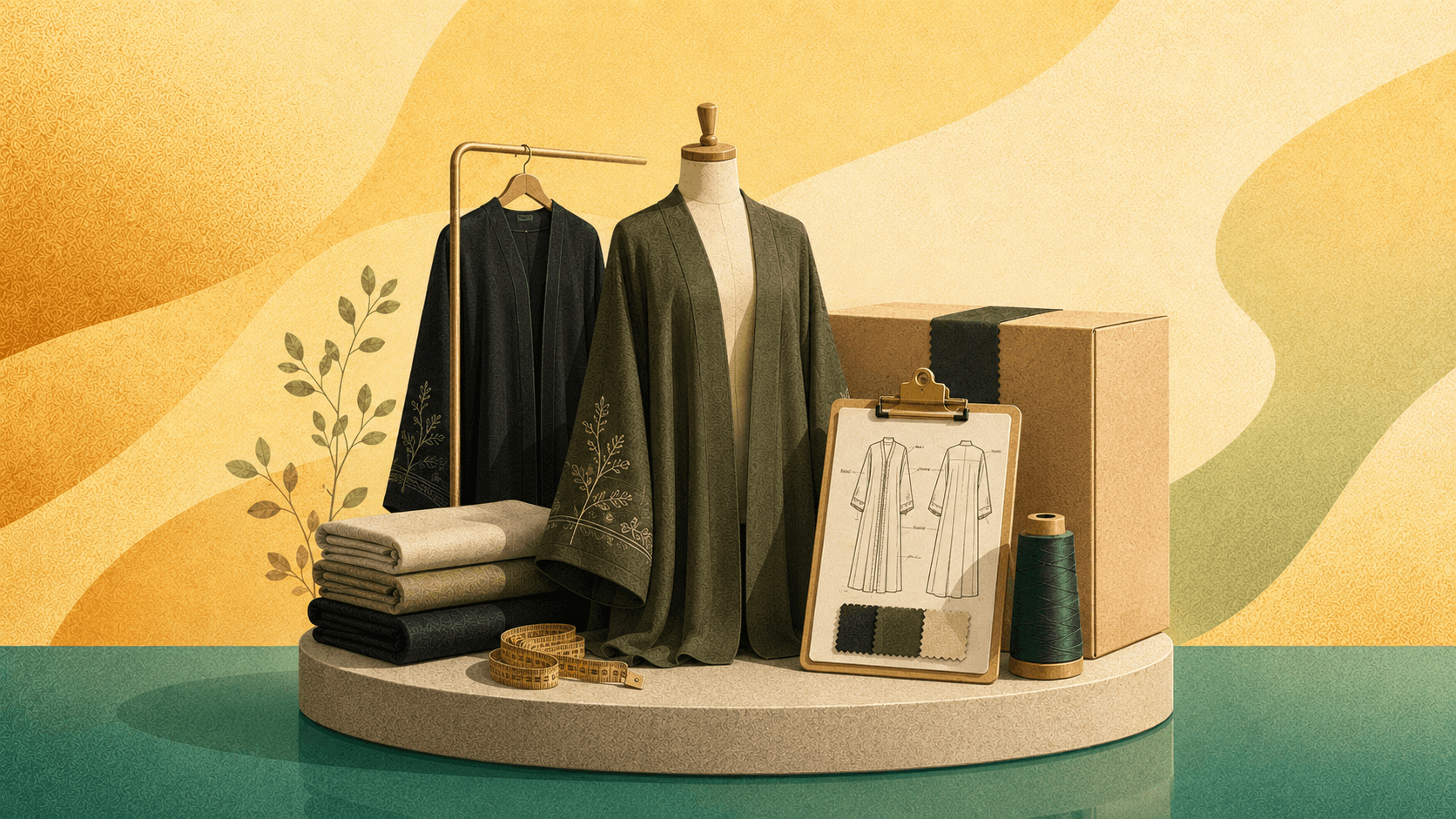
Tailoring abayas vs. buying them ready-made? A comparison to help you choose the right production model
There is no single production model suitable for every abaya project. Buying ready-made helps you test the market and launch quickly, while custom-tailoring reduces your need for stocking large quantities and gives you more room for customization. On the other hand, in-house production makes more sense once demand is proven and you need a product that clearly carries the brand's identity. Compare models based on capital, uniqueness, delivery speed, minimum order quantity, and your ability to control quality and restock—and you can combine them instead of committing to just one model from the start.
15 minutes read
Mohammed Al-Anazi

E-commerce
10 Abaya Project Name Ideas and How to Choose a Name That Builds a Scalable Brand
A good abaya project name isn't the most beautiful name you hear, but the one that is easy to remember, pronounce, and write, and fits the brand's personality today without restricting it tomorrow. Start with several directions related to the style of the abayas, the customer, and the story of the project, test the best names in real-life situations, then check the trade name, trademark, domain, and digital accounts before you invest in the logo, packaging, and store launch.
11 minutes read
Mohammed Al-Anazi


